 Alisie
Threat Simulation Theory, Why We Have Chase and Fall Nightmares
Same forest, same footsteps behind you, legs stuck like you're wading through syrup. Or falling, no floor and no warning. Dreams like these are familiar to almost anyone who remembers their dreams at all. But what if that terror isn't random noise or a glitch, but part of a job the brain does every night?
In 2000, Finnish cognitive neuroscientist Antti Revonsuo proposed something bolder than noise. He suggested the brain doesn't just generate scary dreams, it trains on them.
Sleep as a Rehearsal Space
Revonsuo called the idea Threat Simulation Theory, or TST. The core claim is simple: dreaming may have evolved into a safe space for rehearsing dangerous situations. The body lies still in bed while the brain runs a chase, an attack, a fall, or an attempt to hide, with none of the real risk and all of the repeated practice at spotting a threat and responding to it.
By that logic, dreaming works like a flight simulator. A pilot doesn't wait for an engine failure in real flight, they rehearse it on the ground first, and the brain could be doing the same thing night after night, rehearsing threat recognition, flight, hiding, or defense.
The theory is elegant partly because it's testable. If dreaming really does rehearse threat, danger shouldn't show up in dreams occasionally or by chance. It should show up far more often than it does in waking life.
At First, the Numbers Looked Almost Too Convincing
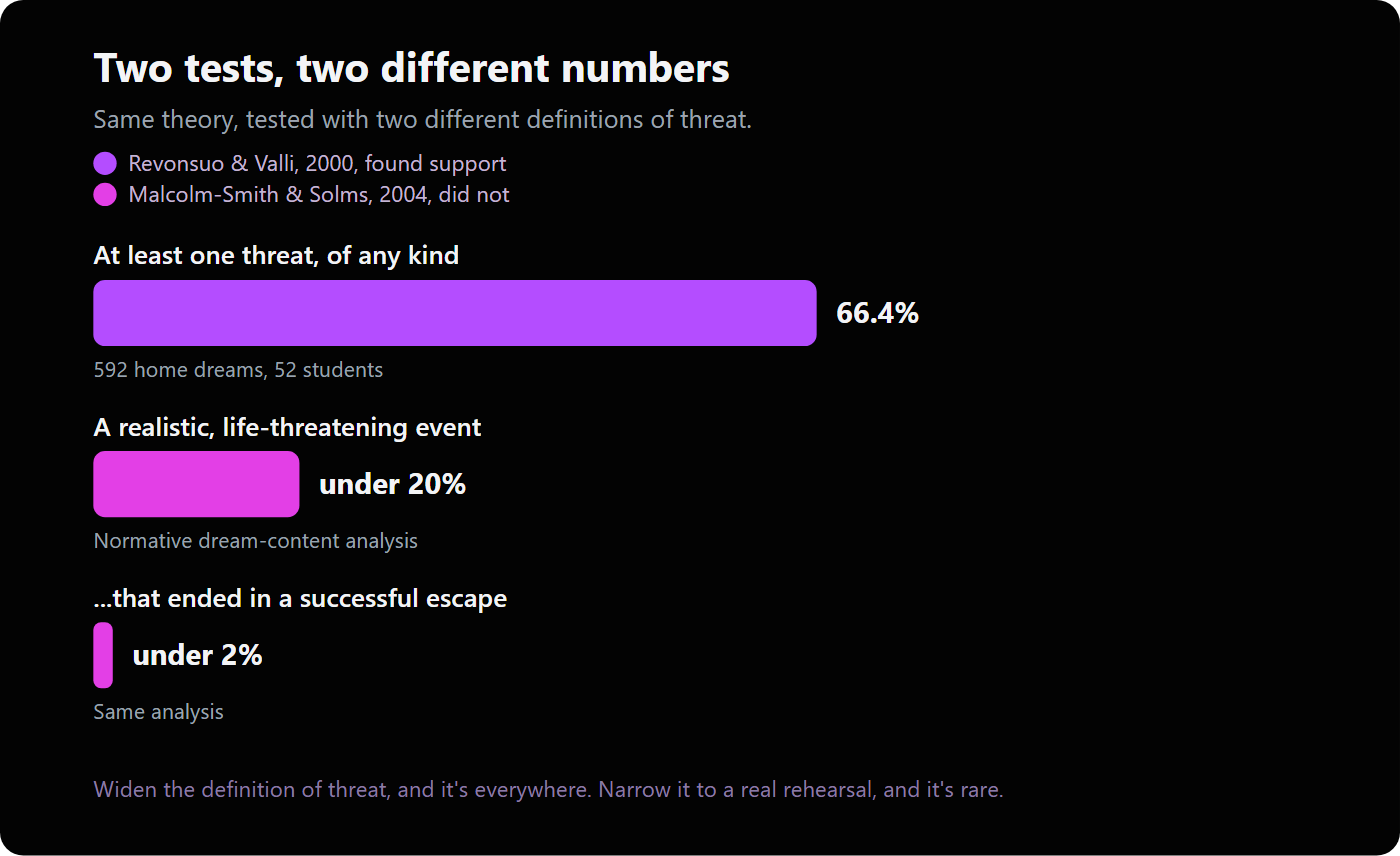
Revonsuo and Katja Valli ran an early test on 592 home dreams from 52 students. At least one threat turned up in 66.4% of the reports, dreamers averaged 1.2 threatening events per dream, and aggression was the single most common type of threat.
The larger normative samples from Hall and Van de Castle look just as grim. About 80% of coded emotions are negative, fear outranks every other single emotion category, and misfortune shows up roughly seven times more often than good fortune. Aggression remains the most common form of social interaction in dreams, and in most aggressive scenes the dreamer is a direct participant rather than a bystander.
On the surface, it all lines up. If the brain builds a training ground every night, why wouldn't it be full of threats?
The Theory Predicts More Than Just Scary Dreams
The trouble is that TST makes a sharper prediction than "threats show up in dreams." The threats have to resemble real survival threats, and the dreamer has to rehearse a competent response to them. That's where the data stop cooperating.
Malcolm-Smith and colleagues found that realistic, life-threatening scenarios made up under 20% of dreams, and a successful escape from one occurred in under 2% of cases. A separate study compared people from a high-crime area of South Africa, where real danger was measurably higher, with people from comparatively safe Wales. The South African group reported fewer threat dreams, not more, directly contradicting one of TST's central predictions.
Plenty of dreams are frightening. Far fewer of them look like the rehearsal the theory describes. You can see the threat without seeing the competent escape: the dreamer runs and doesn't get away, ends up at the edge of a cliff, or simply wakes up having accomplished nothing. That's a strange result for a training system to produce.
Why the Threat Is Always Aimed at You
Still, TST has one argument that's hard to wave off. In a threatening dream, the person under threat is rarely a random bystander, it's the dreamer. In Revonsuo and Valli's analysis, the most frequent targets of dream threats were the dream self and the people closest to it, and when that self acted, the response usually fit the situation.
That makes sense within TST. If a dream is really a rehearsal, it doesn't need an audience, it needs you. What you notice, where you run, whether you hide, whether you fight back, all of it depends on you being the one inside the scene. That's why in a nightmare you're rarely sitting in the front row watching, you're running, hiding, calling for help, pulling on a door that suddenly won't open.
The body offers little help while this happens. REM sleep comes with strong muscle inhibition, so the sleeper doesn't act the dream out physically, which means you can be straining to run with your whole body while staying completely still. Heavy legs, a voice that won't come out, those sensations become part of the plot rather than a glitch in it.
But if TST is right, there's a harder question underneath all this, and it isn't a minor detail. Why does the escape fail so often? A rehearsal system worth the name should produce at least some real wins. In practice, successful threat avoidance in dreams turns out to be rare, and that gap is one of the strongest arguments against the theory's strong form.
What if Rehearsal Isn't the Main Function at All
There's another explanation, one that doesn't require a rehearsal system. Threats might show up often in dreams not because dreaming evolved specifically as a danger simulator, but because dreams process emotionally loaded material from waking life in general, and anxiety, conflict, fear, failure, and loss are exactly the kind of material waking life produces.
That doesn't make TST worthless. It remains a testable evolutionary hypothesis that explains some real features of dreaming well, but the phrase "the brain trains for survival" claims more certainty than the data support. TST is one entry in a wider, unsettled debate over what dreaming is even for, and the argument around it is still live. Some findings look like the predicted threat simulation, others show far too few realistic threats and far too little successful escape.
When a Scary Dream Stops Being Just a Scary Dream
Whatever dreaming's evolutionary function turns out to be, chronic nightmares aren't a purely theoretical question. They disrupt sleep and affect how you function the next day. In PTSD, a nightmare can replay traumatic material or related threats over and over, and nightmares in general show up more often alongside anxiety and depression.
There's also an unexpected medical link. Across three prospective cohorts, weekly distressing dreams in midlife were tied to roughly four times the risk of later cognitive decline, and in older adults, to roughly 2.2 times the risk of dementia. That's a statistical association, not proof that nightmares cause neurodegeneration.
It's worth keeping this separate from REM sleep behavior disorder, in which someone physically acts out a dream because normal muscle atonia has broken down. RBD is a known early marker of certain neurodegenerative diseases, but it isn't the same thing as an ordinary nightmare.
A Recurring Nightmare Can Be Rewritten
From here, the science turns practical, regardless of whether TST holds up. One of the best-studied treatments for chronic nightmares is Imagery Rehearsal Therapy, or IRT. The American Academy of Sleep Medicine recommends it for nightmare disorder and for nightmares tied to PTSD. The method is close to literal: during the day, you recall a recurring nightmare, write it down, change its story or its ending, then spend ten to twenty minutes rehearsing the new version in your imagination.
The first step of that therapy is identifying which specific nightmare keeps coming back, rather than treating "anxious dreams" as one blurry problem. That's where an ordinary dream record earns a role: Alisie pulls the characters, creatures, and places you've tagged in past dreams into a shared list, making it obvious which storyline genuinely recurs and which merely felt familiar because you dreamed something similar once.
A treatment reducing nightmares doesn't prove that nightmares originally evolved as a training tool, those are two separate questions. Lucid dreaming offers another route. If you realize mid-nightmare that you're asleep, you can sometimes redirect the scene, stop the chase, walk away, change the setting, or simply stop treating the threat as real. The evidence here is thinner than for IRT. A 2023 systematic review found only four randomized trials and flagged limited data quality.
So What's Actually Going On
The honest answer probably isn't as tidy as Revonsuo's theory. We know threat, fear, aggression, and other emotionally charged events show up often in dreams. We don't know whether their evolutionary function as survival training has actually been established, and that gap matters.
A nightmare can plausibly be connected to real experience, emotional processing, and mechanisms that once helped the brain model danger, all at once, and science doesn't have to pick just one explanation yet. So the next time you wake up mid-chase or mid-fall, you don't have to file it away as a meaningless malfunction. Seen through TST, it can look like a safe rehearsal of a dangerous situation, it's just that nobody has proven that's actually what dreaming is for.
And if the same nightmare keeps returning, there's no need to wait for the theory to settle the argument first. You can start rewriting it now.