 Alisie
How to Calm Down Before Sleep and Keep Your Dreams
When your head keeps replaying the day at bedtime, a few minutes of slow breathing can help you unwind. You're already lying in the dark, yet part of you is still answering a message, going over what didn't get done and reaching for the phone to check the time. Try giving your attention to the breath for a while instead, with the screen left off.
Then in the morning, give yourself a minute to recall what you dreamed before you go back to your messages. Sometimes all that's left of a whole night's story is one odd detail, and that detail is reason enough to write the dream down.
Count your exhales when your mind drifts back to tomorrow's list
The moment you decide "I have to fall asleep now," you start checking whether it's working. Watching the breath gives you something simpler to do: feel the inhale, follow the exhale, and come back to it whenever you drift off. Along the way you may notice your jaw is clenched or your shoulders are up near your ears, and let them drop a little.
In small studies, slow breathing helped some participants fall asleep more easily, though it won't work the same way for everyone. If you spend every pause just waiting for the next breath in, pick an exercise without holds, one you can relax into rather than push through.
Five ways to breathe tonight
Pick one exercise that's easy to remember. There's no reason to work through all five, especially once you're comfortable and starting to drift.
Belly breathing, no counting
Rest a hand on your belly and feel it rise as you breathe in and fall as you breathe out. Breathe in through your nose and out through your mouth if that's easier, and let your ribcage move freely. Watch that movement for a few minutes and slow the breath down gradually, as far as it stays comfortable.
If you catch yourself thinking about tomorrow's breakfast, just come back to the next exhale. You don't need to fill your lungs to the top or keep every single thought out.
4-7-8 with a long exhale
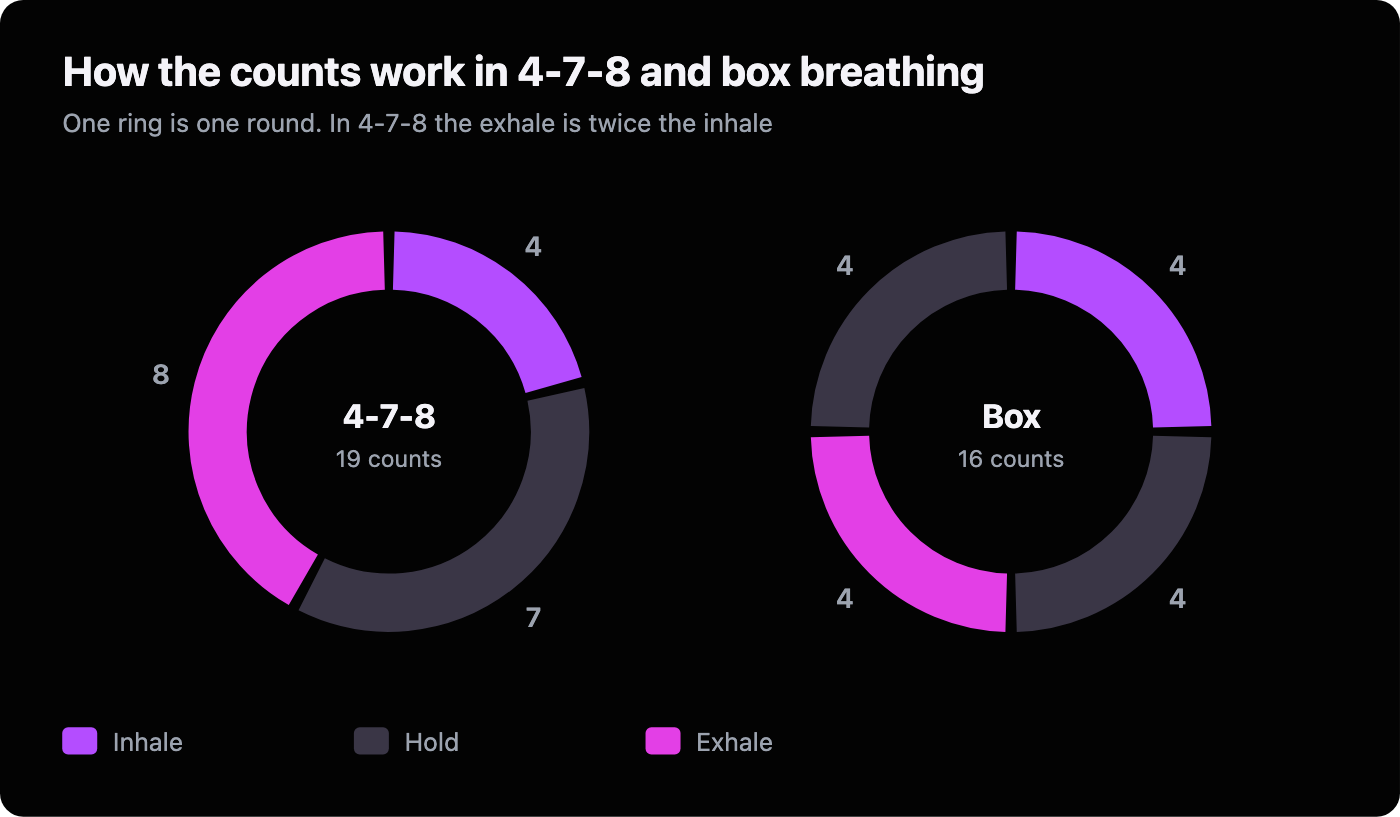
Breathe in through your nose for a count of four, hold for seven and breathe out through your mouth for eight. Start with four rounds, counting in your head at whatever pace feels natural, no stopwatch needed. If the hold feels too long and you find yourself gasping for the next breath, go back to breathing normally and choose a version without holds.
Box breathing
Picture a square and trace its edges in your mind, four counts to a side. Along the first side you breathe in, along the second you pause, along the third you breathe out, and along the fourth you wait again before the next breath. Do a few rounds if both pauses feel easy.
Bhramari, a quiet hum
In this yoga practice you hum softly with your mouth closed as you breathe out, a bit like a thoughtful "mmm." Sit up against a pillow, breathe in gently through your nose and hum for the length of the exhale. Repeat a few times without straining your throat or trying to stretch the sound to the very last of your air.
If someone next to you is already asleep, save the humming for another night and pick a silent exercise for now.
Alternate nostril breathing
This one is easier sitting up, before you settle under the covers. Close your right nostril with a finger and breathe in through the left, then close the left, open the right, breathe out through it and breathe back in. Switch sides and breathe out through the left nostril to finish the round. Repeat a few times without holding your breath, and if your nose is stuffy, choose another practice.
What's worth writing down, even if you remember very little
Say you dreamed about an apartment you moved out of years ago, and for some reason the front door opened onto a beach. After a shower and breakfast, all that may be left is "something about the sea," even though right after waking you remembered both the apartment and the sound of waves just past the doorstep.
If the same place shows up again, you'll be able to compare how it changed and how you felt there. The old apartment can be cozy in one dream, strange in another, or the kind of place you want to leave as fast as you can, and those differences are worth writing down too.
In Alisie you can save the apartment as a location and tag it again in a new entry whenever it comes back. The app shows how often that place turns up in your dreams, and the entries keep the details of each return.
Set up your journal the night before
Open your dream journal before bed so that in the morning you can go straight to writing. Think of a dream you were sorry to lose, and decide that tomorrow you'll try to keep at least one image.
Then put the phone away and try the breathing you picked. If you're getting drowsy, let go of the count, even if you've done fewer rounds than you planned.
Stop the exercise if you feel dizzy, short of breath or more anxious. If you have a heart or lung condition, talk to your doctor about breathing practices, especially the ones with holds. And when trouble falling asleep keeps getting in the way of your life, it's worth getting help rather than hunting for an ever more complicated breathing routine.
In the morning, start with the last scene
Before you open your messages, try to piece together how the dream ended. Where were you, who was next to you, what was happening right before you woke up? Start with the detail you remember best, even if it doesn't add up to a story yet.
For the apartment dream, a few lines would do: "Opened the door, the beach was right there. Could hear the waves, it was warm and I didn't want to go back in." Notes like that bring the moment back far better than two words like "dreamed about the sea," and you can fill in the rest later.