 Alisie
How to Remember Your Dreams: Techniques That Work
Most people can remember far more of their dreams than they currently do. Dream recall - the ability to hold onto a dream after waking - is not a fixed talent you either have or lack. It depends heavily on when and how you wake up, and for the majority of people it responds quickly to a few deliberate habits. You dream almost every night whether or not you remember it. The question is only whether the memory survives the first few minutes of being awake.
You Dream Every Night - You Just Forget Most of It
Forgetting a dream is not the same as not having one. Sleep research is consistent on this point: nearly everyone dreams during sleep, especially during REM, regardless of how much they recall the next morning. When researchers wake people in a lab during REM sleep, those people report a dream around 80-85% of the time. Left to wake up naturally hours later, most of that content is already gone.
The scale of the forgetting is striking. People lose an estimated 90% or more of their dream content within minutes of waking. This is why a dream can feel vivid and detailed the instant you open your eyes, then dissolve before you've finished getting out of bed.
So "I don't dream" almost always means "I don't remember my dreams" - and remembering, unlike dreaming, is something you can influence.
Why Dreams Vanish So Fast
The leading explanation is chemical. During waking hours, a neurotransmitter called norepinephrine helps the brain move new experiences from short-term into long-term memory. During REM sleep - when the most vivid dreams occur - norepinephrine levels in the cortex drop sharply. The dreaming brain is, in effect, running with the memory-encoding system turned down.
That leaves only a narrow window. A dream is most retrievable in the moments right around waking, before the day's input crowds it out, and the longer the gap between the dream ending and full wakefulness, the less of it survives. Sleep scientists call this the arousal-retrieval model: dreams tend to be written into lasting memory only when a brief awakening lets the brain catch them in the act.
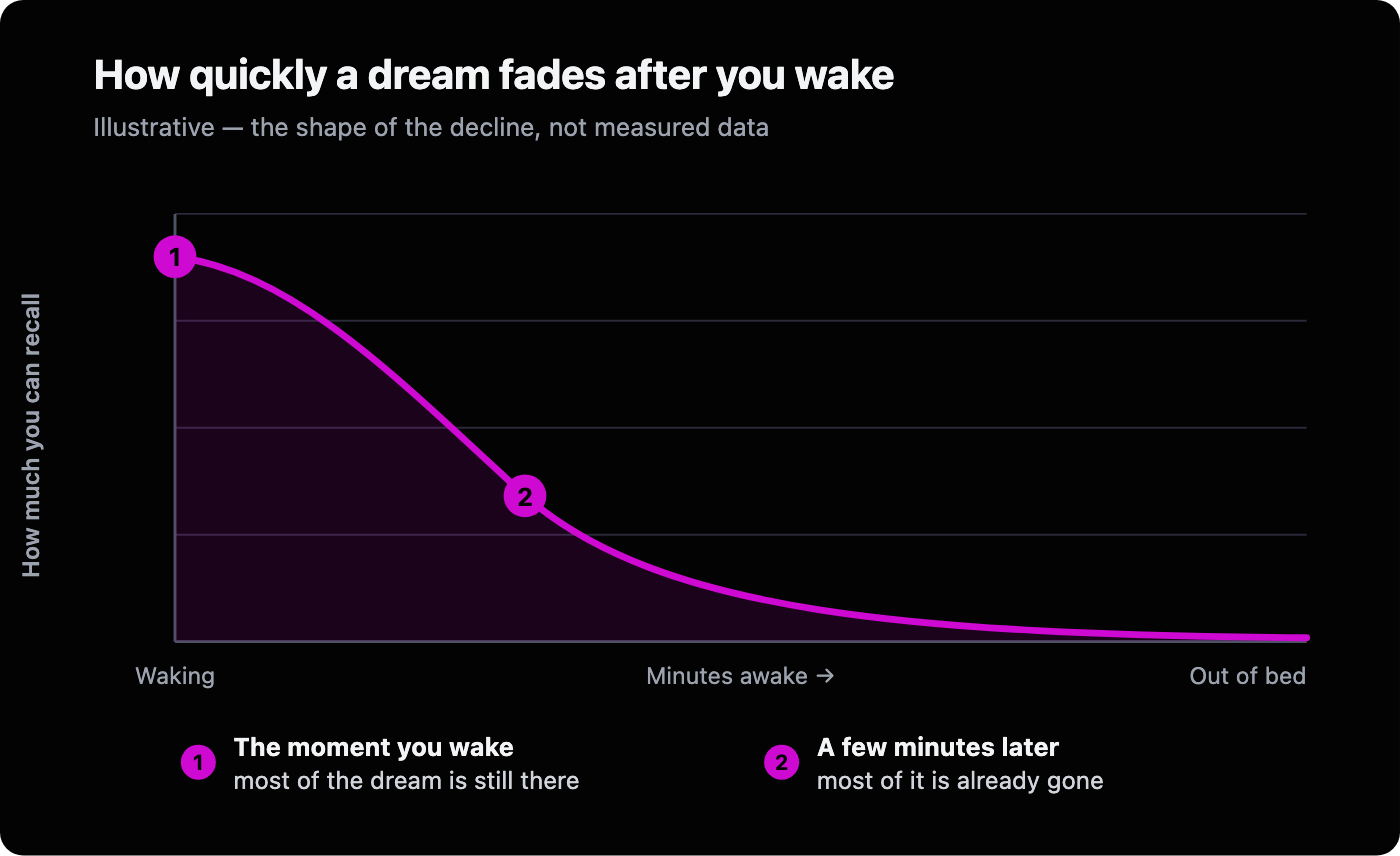
Where the evidence stands: The role of norepinephrine and the arousal-retrieval model are well supported by sleep neuroscience. The frequently cited "90% forgotten within minutes" figure is a reasonable approximation rather than a precisely measured constant - treat it as a rule of thumb, not a hard number.
Some Brains Remember More - Here's Why
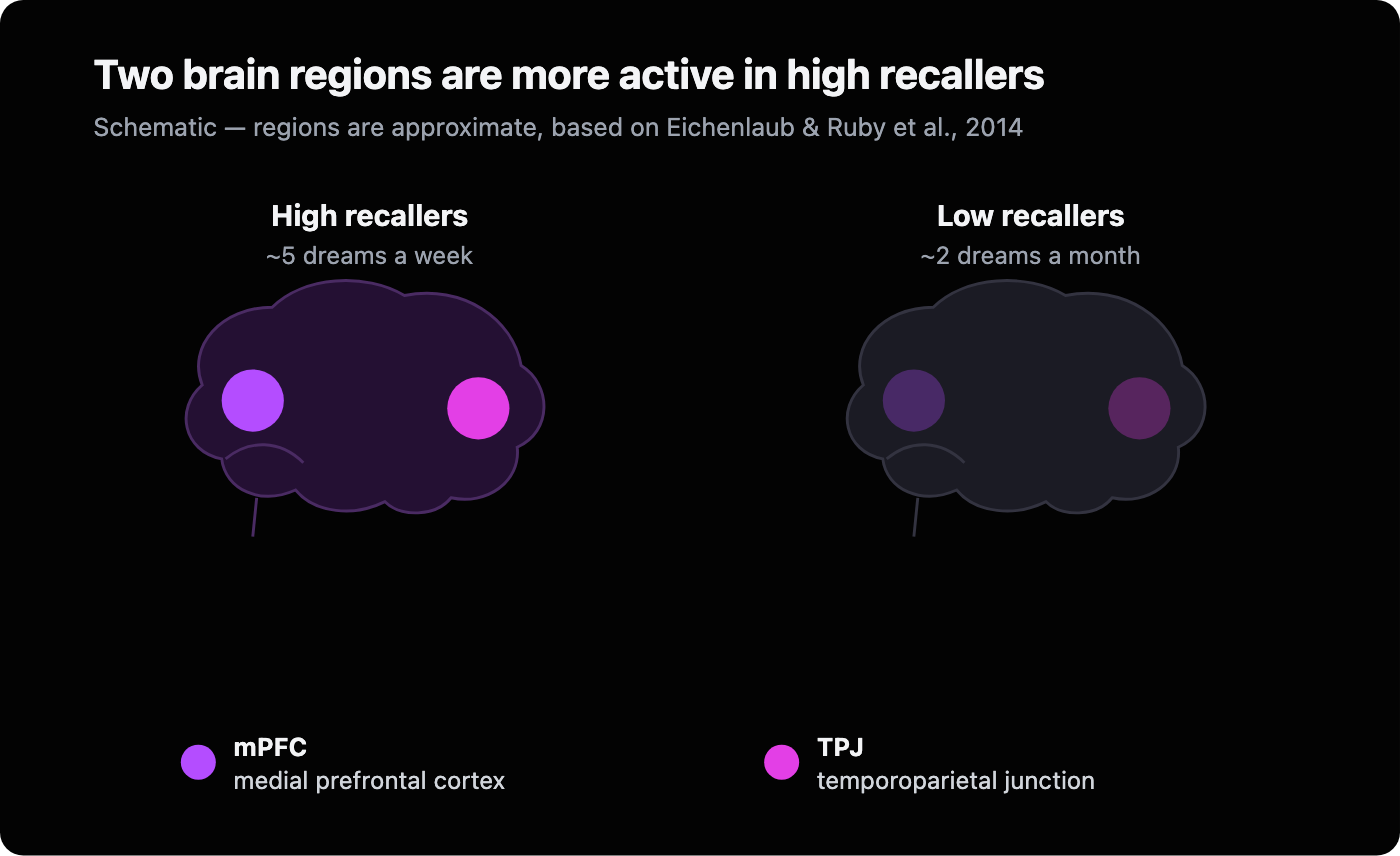
Recall varies enormously between people, and part of that variation is built into the brain. In a 2014 neuroimaging study led by Perrine Ruby's group at the Lyon Neuroscience Research Center, researchers compared "high recallers" (around five dreams a week) with "low recallers" (around two a month). High recallers showed greater activity in two regions - the temporoparietal junction and the medial prefrontal cortex - not only during sleep but also while awake.
The temporoparietal junction helps orient attention toward outside stimuli. A brain more reactive to its environment, the researchers proposed, may wake more often and more briefly through the night, giving dreams extra chances to be encoded. Put simply: high recallers may not dream more, they may just wake in the right way more often.
For some people, then, strong dream recall really is a trait. But it's not the whole picture, and the rest is far more within your reach.
Recall Also Changes Night to Night
If dream recall were purely fixed wiring, you couldn't change it - and you can. A 2025 study in Communications Psychology (Elce and colleagues), following 217 adults, found that whether someone remembers a dream in the morning depends on a mix of stable traits and changeable factors: their attitude toward dreaming, how prone they are to mind-wandering, and their recent sleep patterns. Recall even fluctuated night to night and shifted with the seasons.
That split is the useful part. Your wiring might explain why you start ahead or behind, but the nightly factors - how you sleep, and how much you care about remembering - are the ones you can actually move.
Can You Train Dream Recall?
Yes, and the evidence for this is stronger than for almost any other claim about dreams. Recall behaves like a skill: it improves with attention and practice, and most people see a meaningful difference within about a month of consistent effort. A few habits do most of the work.
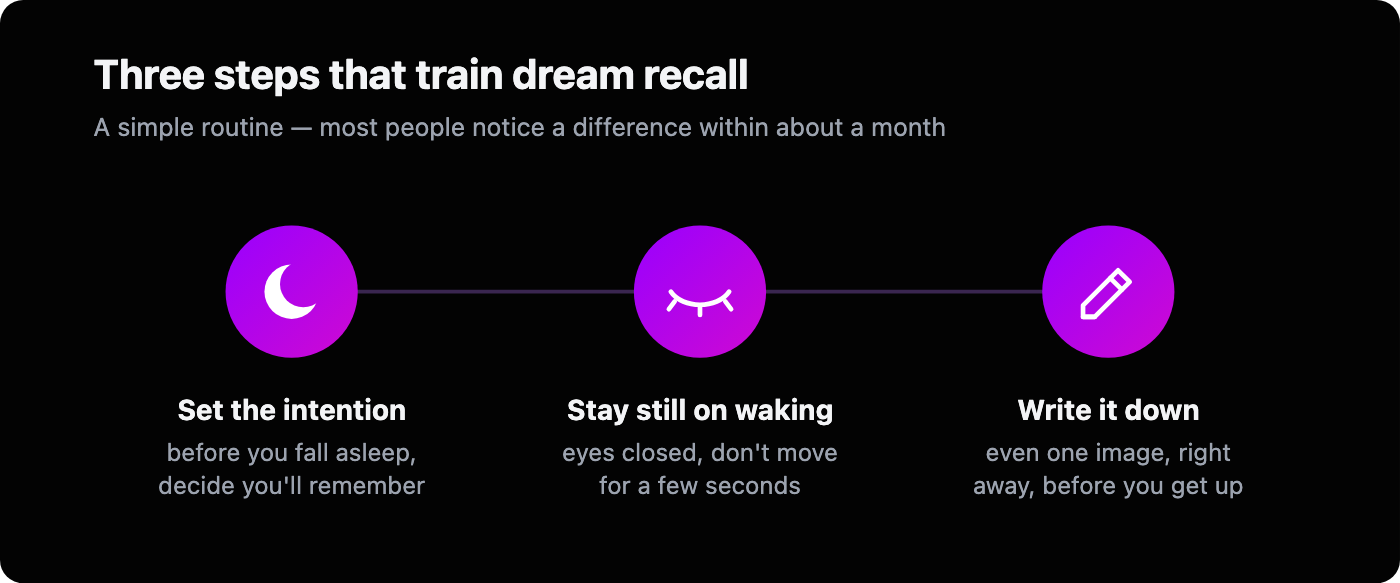
Set the intention before you sleep. Simply deciding, as you fall asleep, that you want to remember your dreams measurably raises the odds that you will. Expectation and attention prime the brain to treat the dream as worth keeping.
Stay still when you wake. The moment you sit up, check your phone, or start planning your day, incoming information begins overwriting the fragile dream memory. Keep your eyes closed for a moment and let whatever fragment is there come back before you move.
Write it down immediately. This is the single most reliable technique, and it works precisely because it beats the forgetting curve. Capturing even a few keywords or images in the first minute anchors the memory before it fades. Over weeks, the act of recording trains your brain to hold onto more - dreams tend to return in greater number and detail simply because you've started paying attention to them.
The practical problem is that "immediately" is hard when you're half-asleep. Reaching for a notebook and a pen, or unlocking a phone and opening an app, is often enough distraction to lose the thread. A dedicated dream journal solves this: Alisie, an iOS dream journal, keeps the capture step within arm's reach. You can set a morning reminder to log your dream, which catches the memory in those first minutes, before the forgetting curve takes it. And setting it the night before quietly does the first step too: you go to sleep knowing you'll be reaching for a dream in the morning, which is the pre-sleep intention itself. Having the right place to record a dream the moment you wake, before the day intrudes, is what turns the habit into results - you're working with the science instead of against it.
What Better Recall Actually Gives You
Everything above is about memory and the mechanics of sleep - how a dream gets from the sleeping brain into something you can still hold in the morning. That's a separate question from what your dreams mean to you, which is yours to decide. What the science can offer is the step before any of that: actually keeping the dream long enough to think about it at all. (For what research has and hasn't established about the rest, see the psychology of dreams - it counts what recurs across a dream series rather than decoding symbols, and a series is exactly what recall gives you.)
And keeping it is worth the effort, whatever you're after. Written down night after night, your dreams build into something a single foggy memory can't give you - recurring people and places, how they shift with stress or a rough night's sleep, the strange logic your mind runs while you're out. It's also the only way to watch what you're learning surface at night: sleep rebuilds the day's memories rather than filing them away, and what you studied tends to come back reshaped and a night or two late, which no single morning could ever show you. That record is also the groundwork for lucid dreaming: without reliable recall, there's very little to work with. Whether you read meaning into your dreams or just find them fascinating, the first requirement is the same - actually having them in front of you.
One small caveat worth clearing up: remembering a lot of dreams isn't a sign you slept badly. Recall tracks the timing of your awakenings more than the overall quality of your sleep. Because brief awakenings help dreams stick, lighter or more broken sleep can mean more recall - but a morning full of vivid dreams is not, on its own, evidence of a restless night.
For most people, all of this starts with a single change: catching the dream in the first minute, before it's gone.
If you want to test this tonight, it comes down to three moves:
- As you fall asleep, tell yourself you want to remember your dreams.
- When you wake, stay still and eyes-closed for a few seconds before doing anything else.
- Write down whatever you have - even a single image - right away, before you get up.
Do that for a week and you'll likely be surprised how much was there all along.