 Alisie
What a Lucid Dream Is and How to Have One
A lucid dream is a dream in which you know you're dreaming while it's still going on — and sometimes, from inside it, you can steer what happens. Spiritual traditions have spoken of it for centuries; in the twentieth century science took it up too, and found it to be a real, measurable state of the brain — first proven in a sleep lab in 1981, and studied since with EEG, fMRI, and even real-time conversations held with people who were asleep. Around 55% of people have had at least one lucid dream. Whether you can reliably train yourself to have them is a harder question, and this is where most of what you'll read online gets ahead of the evidence. Here is what's actually settled, what's promising, and what isn't.
What a Lucid Dream Is — and How We Know It's Real
The defining feature is awareness: at some point in the dream, the realization arrives that none of this is really happening. Full lucidity usually adds a second layer — a measure of control, so you can decide where to go or what to do rather than being carried along. Both can be partial: you might notice you're dreaming for a few seconds and lose it, or become aware but be unable to change anything.
For a long time this was impossible to study, because a dream report is only ever collected after waking, and memory of a dream is famously slippery. How do you prove someone knew they were dreaming at the time?
The answer came from a quirk of REM sleep, the stage where vivid dreaming happens. During REM your body is essentially paralyzed — a safety mechanism that stops you acting out dreams — but your eyes still move. So a dreamer who becomes lucid can send a message out: by moving their eyes in a prearranged pattern, left-right-left-right, while a sleep lab records both the eye movements and the brainwaves confirming genuine REM sleep. In 1981, Stephen LaBerge and colleagues at Stanford did exactly this, publishing the first rigorous proof that people can be conscious and communicating while demonstrably asleep. (A British researcher, Keith Hearne, had recorded a similar signal from the lucid dreamer Alan Worsley a few years earlier, in 1975.) The eye-signal method is still the backbone of lucid-dream research today.
The Brain in a Lucid Dream Is Half Awake
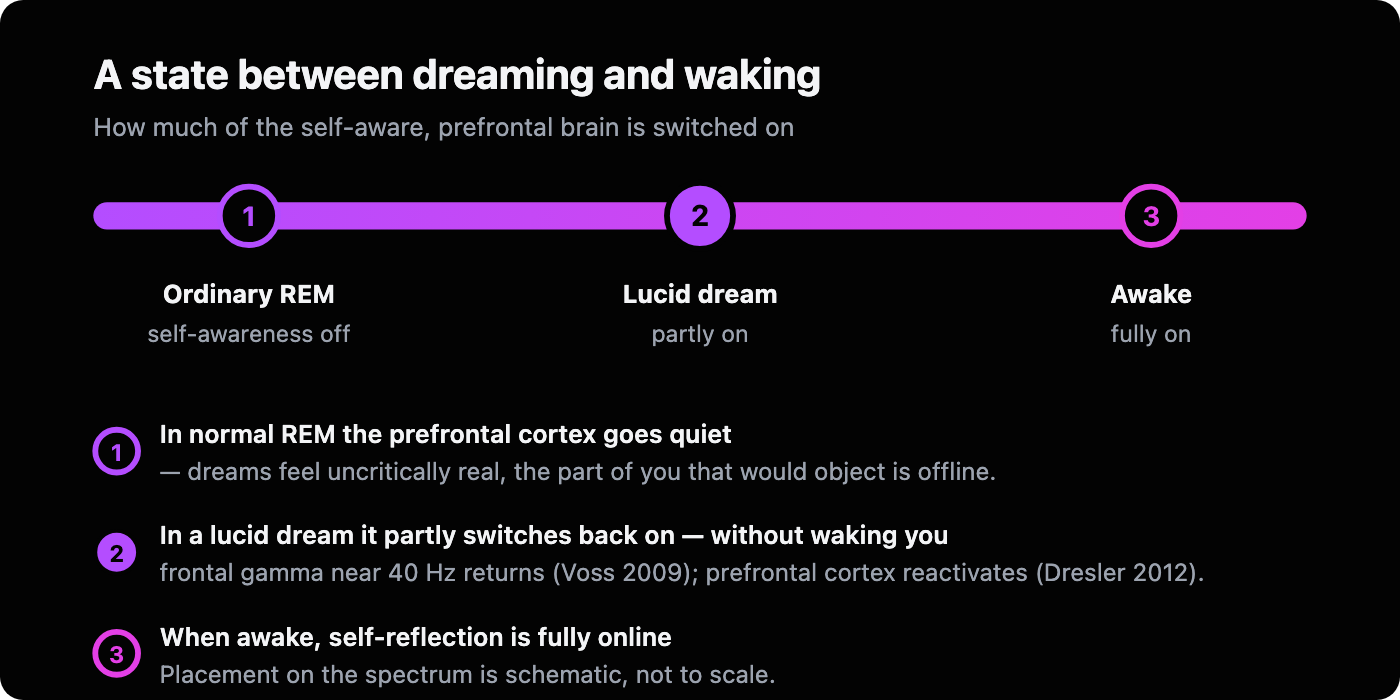
Lucid dreaming isn't quite waking and isn't quite ordinary dreaming — it's a genuine third state, with fingerprints of both.
In normal REM, the front of the brain — the prefrontal cortex, seat of self-reflection and the "wait, does this make sense?" faculty — goes quiet. That's why dreams feel so uncritically real while you're in them: the part of you that would object is offline. What seems to happen in a lucid dream is that this machinery partly switches back on without waking you up.
Two lines of evidence support this. A 2009 EEG study by Ursula Voss and colleagues found that lucid REM carries a distinctive rise in frontal gamma activity around 40 Hz — a signature associated with waking self-awareness — that ordinary REM lacks. And a 2012 study from Martin Dresler's group at the Max Planck Institute, combining EEG with fMRI, showed that during lucid dreaming the prefrontal cortex and precuneus, regions tied to self-awareness and sense of self, partly reactivate. So the short version is: a lucid dream is your dreaming brain running the usual REM show while the self-aware part of you comes back online in the front seat.
Scientists Have Held Conversations With Dreaming People
The most striking recent result turns the eye-signal trick into something closer to dialogue. In 2021, four independent labs in the United States, France, Germany, and the Netherlands — reporting together in Current Biology — managed two-way communication with people in a lucid dream.
Experimenters asked sleeping participants questions from the outside: yes-or-no questions, and even simple arithmetic like "eight minus six," delivered by spoken words, flashing lights, or taps on the skin. The lucid dreamers perceived the questions and answered from inside the dream, using coded eye movements or small facial-muscle twitches — and they answered correctly more often than chance across 36 participants. One person, asked to subtract, signaled the right answer with a series of eye movements without ever waking.
It's worth being precise about what this shows and doesn't. This was not fluent conversation; the signals were sparse, effortful, and often missed entirely. But it demonstrated something genuinely new: a person who is asleep and dreaming can perceive the outside world, understand a spoken question, perform a calculation, and reply in real time. For researchers, that opens a channel into the dreaming mind that didn't exist before.
About 55% of People Have Done It at Least Once
Lucid dreaming is far more common than its reputation suggests. A 2016 meta-analysis by David Saunders and colleagues, pooling 50 years of studies, put the numbers on solid ground: roughly 55% of people have had at least one lucid dream in their lifetime, and about 23% have them once a month or more. So this isn't a rare gift held by a special few — a majority have brushed against it, usually spontaneously and often in childhood.
That last point matters for anyone trying to learn. Lucid dreaming tends to be more frequent in children and adolescents and to taper off with age, and it's reported somewhat more by people who remember their dreams well and by those who meditate. None of which makes it a fixed trait — which brings us to the question everyone actually asks.
Can You Train Yourself to Lucid Dream?
Yes, to a point — and the honest answer stops well short of the confident promises you'll find elsewhere. Several techniques reliably push the odds above chance, but none is a switch, results swing widely from person to person and night to night, and the methods that shine in a sleep lab work less well at home. Treat it as a learnable skill with real but limited evidence, not a guaranteed one.
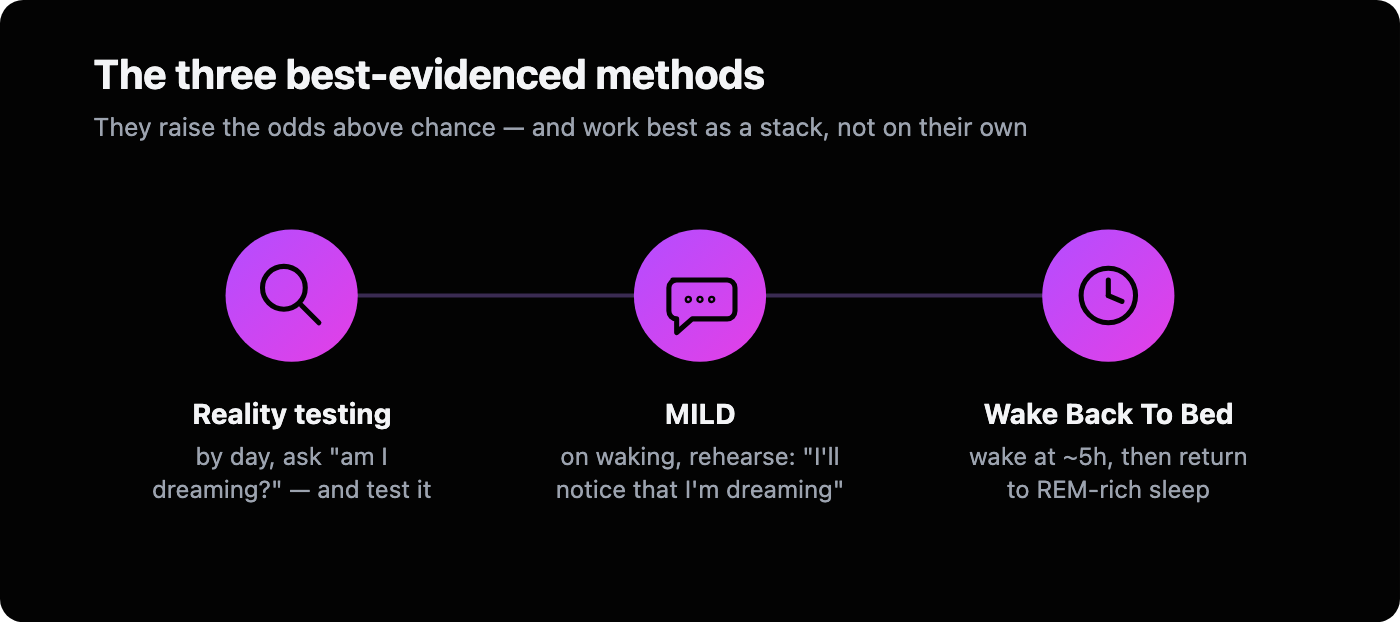
The evidence-backed methods cluster into a few approaches, and they work best in combination.
Reality testing. Several times a day, you genuinely ask "am I dreaming?" and test it — try to push a finger through your palm, or read a line of text, look away, and read it again (in dreams, text tends not to stay stable). Done as a habit, the reflex eventually fires inside a dream, and the failed test tips you off. The one weak spot is simply forgetting to check — a reminder set at your own times and interval keeps the habit from riding on memory.
MILD (Mnemonic Induction of Lucid Dreams). Developed by LaBerge, this is a memory trick aimed at intention. When you wake from a dream, you form and rehearse a clear resolution — next time I'm dreaming, I will recognize that I'm dreaming — and hold it as you drift back to sleep.
WBTB (Wake Back To Bed). You wake after about five hours, stay up briefly, then return to sleep. Because REM is concentrated in the later part of the night, you're going back into REM-rich sleep with a primed mind. WBTB doesn't do much alone, but it strongly amplifies the others.
How well does the stack work? In the 2017 National Australian Lucid Dream Induction Study, Denholm Aspy and colleagues tested these methods in 169 people. Combining reality testing, WBTB, and MILD produced lucid dreams on about 46% of nights for participants overall — and around 54% among those who managed to fall back asleep within five minutes of finishing the MILD rehearsal. Baseline dream recall and how fast you fell asleep were the strongest predictors of success. A larger 2020 follow-up run online, in the messier conditions of real life, again beat baseline but with lower success rates and high dropout — a useful reminder that a controlled study and your own bedroom are not the same place.
There's a common thread under every one of these methods, and it's easy to miss. They all depend on remembering your dreams. You can't rehearse the MILD intention on a dream you don't recall; you can't notice the recurring "dream signs" that trigger lucidity if you never wrote them down; reality checks are cued by patterns you only spot across a written record. Reliable dream recall and a dream journal aren't an optional extra — they're the ground floor the whole practice stands on.
If you already keep a dream journal, half the work is done — the rest is about keeping the techniques above from falling apart into scattered attempts. Alisie, an iOS dream journal, gathers that loop in one place. In your own entries you tag the dream signs — along with the characters, creatures, and places that appear — and the app tallies them, so the recurring ones surface over time and you learn what to watch for. Reality-check reminders you set at your own times and interval — the daytime habit that's otherwise easy to forget. And goals for a lucid dream you set ahead of time — what to do once you're inside — so that when lucidity hits you don't freeze or wake yourself from the excitement, but act on a plan. Dream signs, reality checks, and goals sitting right beside the entries themselves is what separates working on lucidity from just keeping a journal.
Why It Lives Inside REM Sleep
Lucid dreaming is a REM phenomenon, and that isn't a trivia detail — it explains the timing of every technique above. REM periods get longer as the night goes on, so most of your REM, and most of your best shot at a lucid dream, falls in the last couple of hours before you'd normally wake. That's the whole logic behind Wake Back To Bed: you're deliberately steering yourself into the REM-dense home stretch of the night. If you want the fuller picture of how the stages fit together, see our guide to the sleep cycle; the one-line version is that lucid dreams cluster where REM clusters, toward morning.
What It's Good For — and Where the Evidence Thins
Set aside the more grandiose claims and one genuine, evidence-backed use stands out: nightmares. Learning to become lucid inside a recurring nightmare — and then to change its course — can reduce how often nightmares happen and how much distress they cause. The research here is modest in scale but consistent, and it comes with an important nuance. In a 2016 study of combat veterans, it wasn't awareness alone that helped; it was control. People who became lucid but couldn't alter the dream got little relief. The benefit came from being able to change what was happening. It's one of several evidence-backed options — see our guide to what causes nightmares and what helps for the fuller picture, including the first-line behavioral treatment.
For post-traumatic stress more broadly, the evidence is thinner and mixed — lucid-dream therapy hasn't reliably reduced core PTSD symptoms, though some studies report lower anxiety and depression alongside it. And the popular ideas that lucid dreaming can be used to rehearse real skills or unlock creativity rest on small, early studies. They're interesting leads, not established results. If you see lucid dreaming sold as a route to self-improvement, that's the part running ahead of the science.
The risks are real but generally mild. The main one is sleep disruption: waking yourself deliberately and running effortful induction routines can fragment your night and leave you groggy, and most bad experiences trace back to failed attempts or low-control dreams rather than successful ones. One responsible caution: people prone to blurring the line between inner and outer reality — those on the psychosis spectrum, or with dissociative conditions — should be careful with practices built on questioning what's real, and check with a clinician first.
Not Only Science
Lucid dreaming has a second history alongside the laboratory one. It was described long before the EEG: Tibetan dream yoga worked with it more than a thousand years ago, and in the twentieth century Carlos Castaneda wrote about "dreaming" as a practice of attention, relaying a teaching he attributed to the Toltecs. For some readers that tradition, not the sleep-stage charts, is the way in.
Science passes no verdict on that experience. It tests the testable — the eye signals, the gamma rhythm, how often lucid dreams occur — and stays silent on what a person in such a dream undergoes and what it means to them. That isn't "disproven," it's simply outside its instruments. The practice is the same either way: awareness, intention, and a journal are what any path needs.
The Honest Summary
Lucid dreaming is real, it's a REM-sleep phenomenon, and it's a hybrid state where the self-aware brain comes partly back online mid-dream — all of that is well established, down to lab conversations held with sleeping people. It's common: most of us have had at least one. It can be trained, but only somewhat; the best methods raise your odds above chance without ever guaranteeing a result, and they lean entirely on remembering your dreams in the first place. Its clearest practical payoff is calming recurring nightmares. Beyond that, the promises get bigger than the evidence.
If you want to try, don't start with a technique — start with what every technique leans on: a record of your dreams. If you already journal, look at what recurs in it; those dream signs are the cues your lucidity will hang on. If you don't yet, that's the first step. The habit pays off twice, incidentally: counting what recurs across a dream series is also the only method the psychology of dreams has ever found for learning anything real about your own.