 Alisie
Being Chased in Dreams
The morning after a chase dream leaves you with one question: who was that. Who was I running from, what was the figure at my back, what does it mean. And it's almost always the wrong question, because about the pursuer on a single night, the science can tell you surprisingly little, while about whoever chases you night after night, it can tell you something that matters.
So start not with who was chasing you, but with what was happening to your legs.
Why you can't run
The first thing people remember about a chase dream isn't the pursuer but their own helplessness, namely you can't run. Your legs turn to lead, the ground drags, you're wading through wet cement while the thing behind you closes in. And this is the one detail with a solid explanation, steadier than anything about the chase itself.
That sluggishness isn't in your head, it's in your body. Almost all dreaming happens in REM sleep, and during REM the brainstem paralyses your voluntary muscles almost completely, a state called REM atonia. It's a safety catch, because it stops you from physically bolting out of bed and actually running. What comes next is a guess about how the feeling arises, namely that your motor cortex fires the command to run while the muscles stay switched off, and the dream reads the mismatch as legs that won't obey. It's a convincing guess and a widely repeated one, but no one has caught it in the act, so take it as a good hunch about the mechanism, not a proven fact.
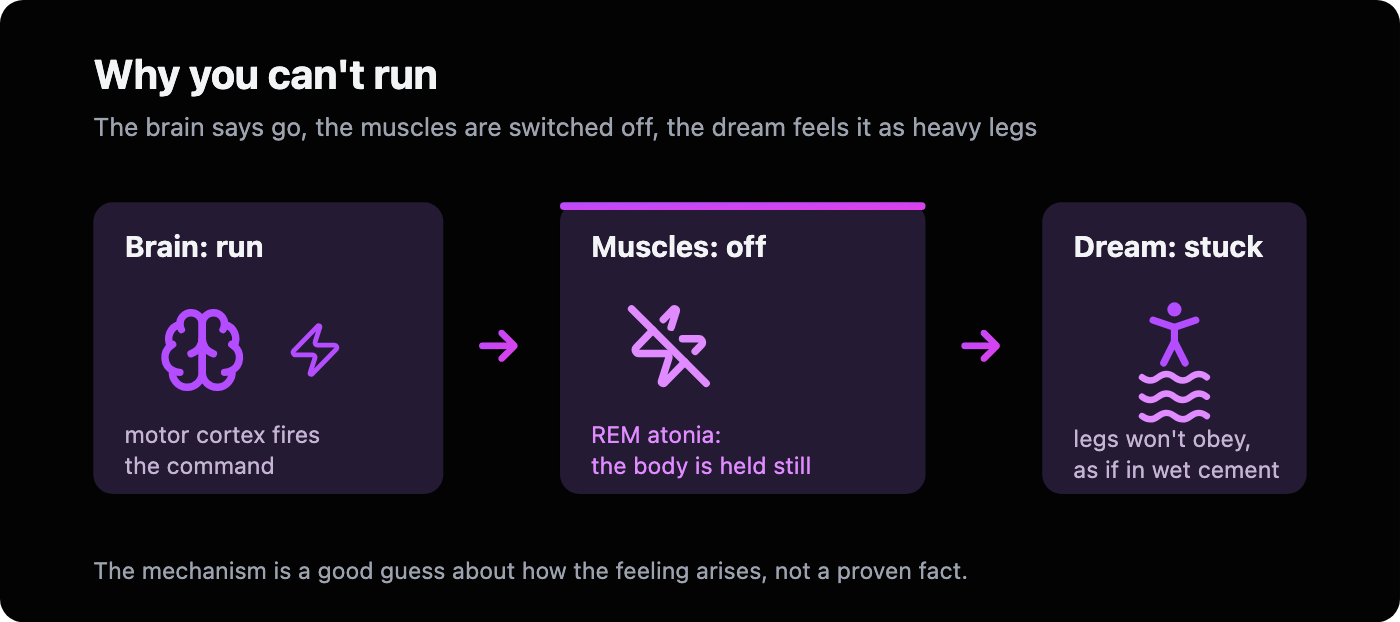
One thing it is not is sleep paralysis, which people mix it up with. That's the same muscle shutdown, but you're awake and aware of it, lying in bed, mind clear, body locked. The heavy legs of a chase are a different thing, felt while you're still asleep and inside the scene. Same atonia underneath, and that's where the resemblance ends.
The ancient drill the brain runs at night
Now the frequency, because here it isn't decoration but half the answer. Being chased isn't just common, it's more common than any other dream. In the big dream survey, Tore Nielsen and colleagues put it first out of some fifty-five themes: 81.5% of people have had a dream of being pursued at least once, ahead of falling and ahead of everything else. And it's not a quirk of one country, because Japanese and American respondents order the list of typical dreams strikingly alike, with being chased at or near the top of both.
If nearly everyone has it, there's a guess about why the brain bothers. The Finnish researcher Antti Revonsuo proposed that dreaming is a kind of threat rehearsal, namely the dreaming brain runs simulations of danger and escape, because ancestors who spent their nights practising the getaway had a slight edge at doing it awake. Being chased is the purest version of that drill.
It's an elegant idea, and it's worth naming what it is, a hypothesis about the function of dreaming, not a proven fact. The numbers don't flatter it. A threat of any kind shows up in only about 21% of dreams, only around 8.5% of dreamers report one realistic enough to be life-threatening, and a realistic escape follows in perhaps a third of those. No one has shown that a rehearsed escape actually helps you awake. So threat simulation explains beautifully why the chase feels so ancient, but it's a guess about why we dream at all, not something we know.
Who's chasing you: the figure in the dark
And when you do catch a look at the pursuer, who is it? Here the content researchers have real data, not guesses. In Calvin Hall and Robert Van de Castle's classic analysis of thousands of dream reports, the dreamer is far more often the victim of aggression than the aggressor, and the two most likely to come at you are an unfamiliar man and an animal. Strangers in dreams do skew male, and an aggressive encounter is likelier with an unknown man than with someone you know.
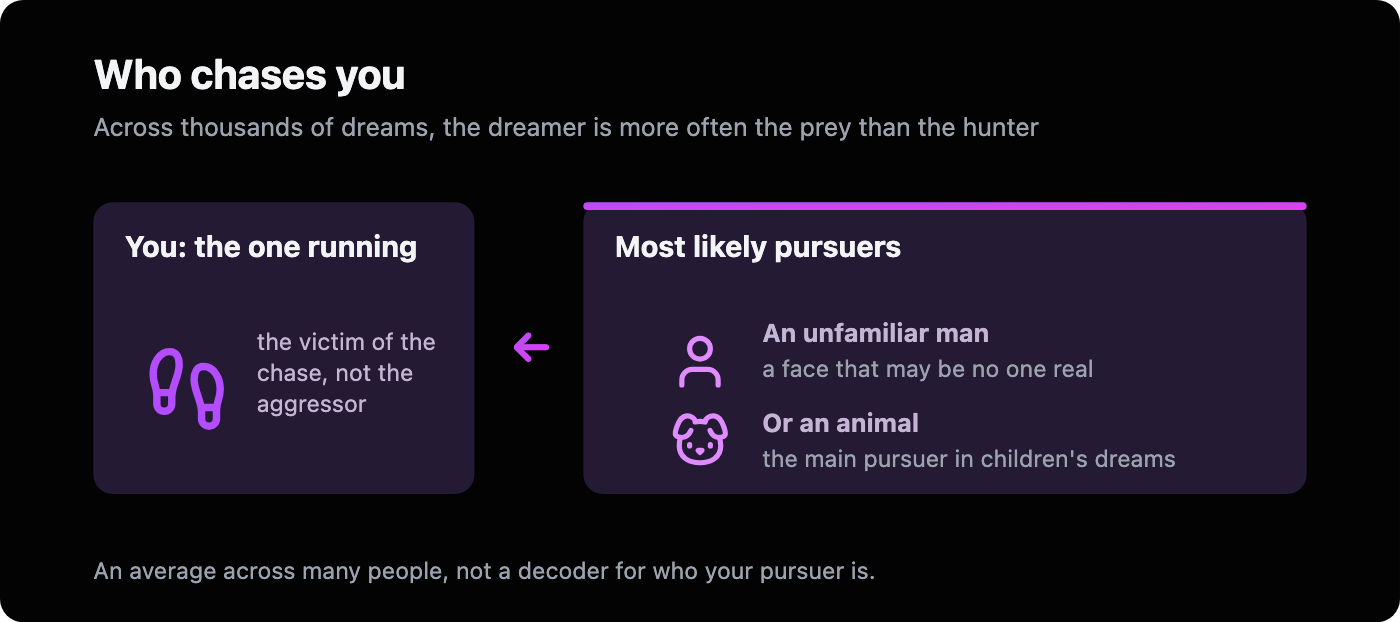
But that's an average over a huge mass of people, not a key to your dream. It tells you what the pursuer tends to be; it doesn't tell you that the man chasing you stands for someone specific in your life. Often he stands for nobody at all, and he's a stranger, a face your brain assembled that was never anyone at all. That's the recurring stranger from the science of dream characters, no one in waking life, yet back again and again in sleep. Who your pursuer is, and whether he means anything, is not something a table of averages can answer. Only your own dreams can.
When it isn't a person
Plenty of times the one at your back isn't a person at all, but a dog, a bear, something with teeth. Or something you can't even name, a shape, a presence, a creature out of no zoology. Animals are a real share of dream pursuers, and in children they're the main ones, and a beast at your heels is one of the most common childhood dreams, and it never quite drops off the adult list either.
And again the pull is toward a dictionary, a wolf means one thing, a monster another. And again it misses, for the same reason. But the beast didn't come from nowhere. Like everything in a dream, it's built from your own material, the things that scare you, the films and stories that got under your skin, a fear that hasn't yet found a face. That's a world away from a bear always means X. The creature really is about you, it just isn't assembled from a shared code, but from yours. Which is why a nameless thing that comes back several nights running is worth more attention than any single monster: the signal is the repeat, not the beast.
And the repeat is exactly what a single memory can't hold. Alisie keeps every recorded night searchable, so the shape at your heels three weeks ago and the one last Tuesday sit a query apart, so you go looking for the beast and find out how many times it has already been back.
The bedtime stories being chased collects most of
The first is from the dream dictionary, namely if you're chased, you're running from something in waking life, a problem, a feeling, a part of yourself you won't face. It's a tidy formula, and it fails the way every dream dictionary fails, because there's no fixed code, because there's no universal dreamer. The same pursuer means one thing to someone who spent yesterday dodging a hard conversation and something else to someone who watched a thriller before bed. (Freud had his own version, reading the pursuer as a disowned part of the self, a curiosity in the history of ideas, and nothing to build on.)
The second, if the thing catches you, or you die in the dream, you die for real. You don't. A dream is something that happens in the brain, not the body; people get caught, bitten, even killed in dreams and wake up perfectly fine. Nothing that happens in the chase reaches past your own skull. And a chase isn't automatically a nightmare, because many are tense without ever tipping into the real terror that jolts you awake. The two overlap plenty, but a chase and a nightmare aren't the same thing.
The right question isn't "who" but "who again"
Back to the question from the first line. "Who was I running from tonight" is a dead end, because the pursuer is built from your life, but what he means can't be read off a single night. What you can do is turn him from a nameless shape into someone with a name, and that changes everything.
It's simple enough, write the dream down while it's fresh, before memory erases it, and mark whoever chased you as a figure of their own, a person as a character, a beast or a thing as a creature. Give it a name, set its status to enemy. From then on it stops being anonymous. It gets a card of its own, and every night it chased you gathers there by itself.
And that's where you see what no single morning shows, the stranger who isn't real, yet turns up for the eighth time. Do that across enough nights and the faceless figure at your back slowly takes on a face, a habit, a place in your life, and stops being just "someone who chased me."