 Alisie
Dreams About Exams and Being Late
You are back in a building you know: there is a test ahead, and you have to find the room or recall a subject you have not prepared for at all. Sometimes the dream makes it clear from the start that the time is gone, with a blank sheet in front of you and the answers missing at the exact moment they were needed. Your exams ended many years ago, and the scene has come back whole, heart rate included.
A dream like this predicts nothing, and it is anything but rare, because the school plot is among the most common scenes people dream at all.
Two people in three have had this dream
In a survey that asked 1,181 Canadian students whether they had ever experienced each of 55 widespread themes, school, teachers and studying drew 67.1% and took fourth place (Nielsen, Dreaming, 2003). Arriving too late, for a train say, stands fifth there, and failing an examination eleventh. Only being chased, sexual dreams and falling come in above school.
Women named the school theme more often than men, 71.3% against 56.9%, and recalled failure more often as well, 48.1% against 37.2%.
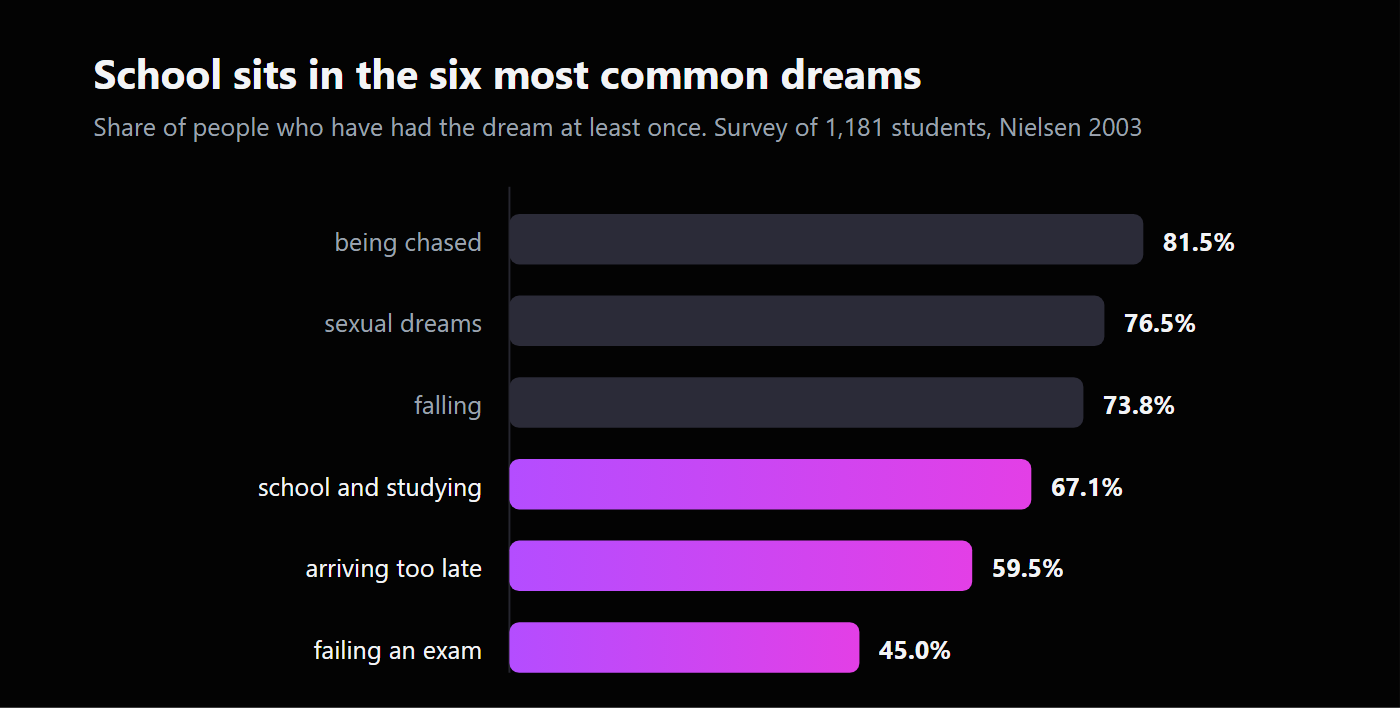
What was counted is lifetime experience, meaning whether you have ever had such a dream, not how many times it came last year.
A dream about failing predicts no failure
In 2014 a rare combination came together in Paris. First-year students on the medical track at Pierre and Marie Curie University were asked about their dreams during the entrance competition itself, and their grades were taken afterwards from the university records (Arnulf, Consciousness and Cognition, 2014). Out of 2,324 students, 719 filled in the questionnaire.
A dream on the night before the exam came to 308 of them, and 60.4% of the reports they sent in were about the exam itself.
The average grade on a scale from 0 to 20 among those who dreamed of the exam the night before was 8.5. For the rest it was 7.8, and the difference is statistically significant. The more often such dreams arrived during the term, the higher the grade turned out to be, although the connection there is very weak.
"Dream of the exam and you will do better" does not follow from this. It is an observation rather than an experiment, so it does not separate cause from effect, and the reverse reading is just as plausible, since whoever put more into preparing had the exam on their mind more often, and in their dreams with it. The gap between the averages is under one point out of twenty against a spread of about three. And the questionnaire was filled in by students who had on average been doing better than those who left it alone, which skews the sample.
The superstition does not survive even that. A bad plot on the eve of a test proved to be no herald of a bad result, and in this sample it came alongside a slightly higher grade.
What the dream actually shows
Something almost always gets in the way of reaching the exam or answering at it.
Across the term the most frequent plot was trouble that leaves a person late, 28.7%. Then came difficulty answering and, less often, passing successfully. Of the dreams about the exam, 78% held a problem at the exam itself, and where a threat appeared, that threat was almost always failure.
The variants are familiar: you hunt for the right room on the wrong floor and never arrive in time, you sit over a sheet that stays blank, you walk into somebody else's office, you hear the question and find you cannot answer. Each time something stands between you and the exam, and the subject itself has almost nothing to do with it.
That is why the same plot returns years after graduation. What holds inside it is a recognisable arrangement in which you have to be in the right place on time and able to answer, while the outcome rests on how you are judged. The particular subject and any real test of knowledge never survive until morning.
A place repeats more readily than a plot, the same corridor or the same lecture room. In Alisie you set that place up as a location of its own and mark it on every entry where it turns up. The school corridor is then visible in the journal under its own name instead of dissolving into the retelling.
The content of the dream had no bearing on the outcome
The authors looked separately for a link between what was dreamed and the grade, and found none at all. The emotion carried through the dream was unrelated to the mark. Whether the dreamer passed or failed inside the dream made no difference either, and difficulty answering said nothing about the grade to come.
Dreams about being late were counted on their own, 7.4 points against 8.9 for everyone else. That difference never reached the significance threshold, so "late in the dream, worse on the day" cannot be drawn from it. Anxiety levels, lost sleep and sleep quality before the exam were unrelated to the grade as well.
What was measured here is that the content of an exam dream bears no relation to the mark for the real thing. That dream content in general is meaningless, or assembled at random, does not follow from that and was never claimed in the study.
A dream dictionary works the other way round, taking one detail of the plot and issuing a ready-made future under it. In this situation at least, the approach found nothing to stand on, since failure in the dream did not report that the person would fail awake, and a brilliant performance promised nothing.
The exam fades with age, the school stays
In the same Nielsen sample the failure theme weakens with age. About half of the participants of 18 and under had seen such a dream at least once, against appreciably fewer of those aged 19 and over, and the difference is significant. The school scene as a whole holds its ground, with no difference between the age groups to speak of.
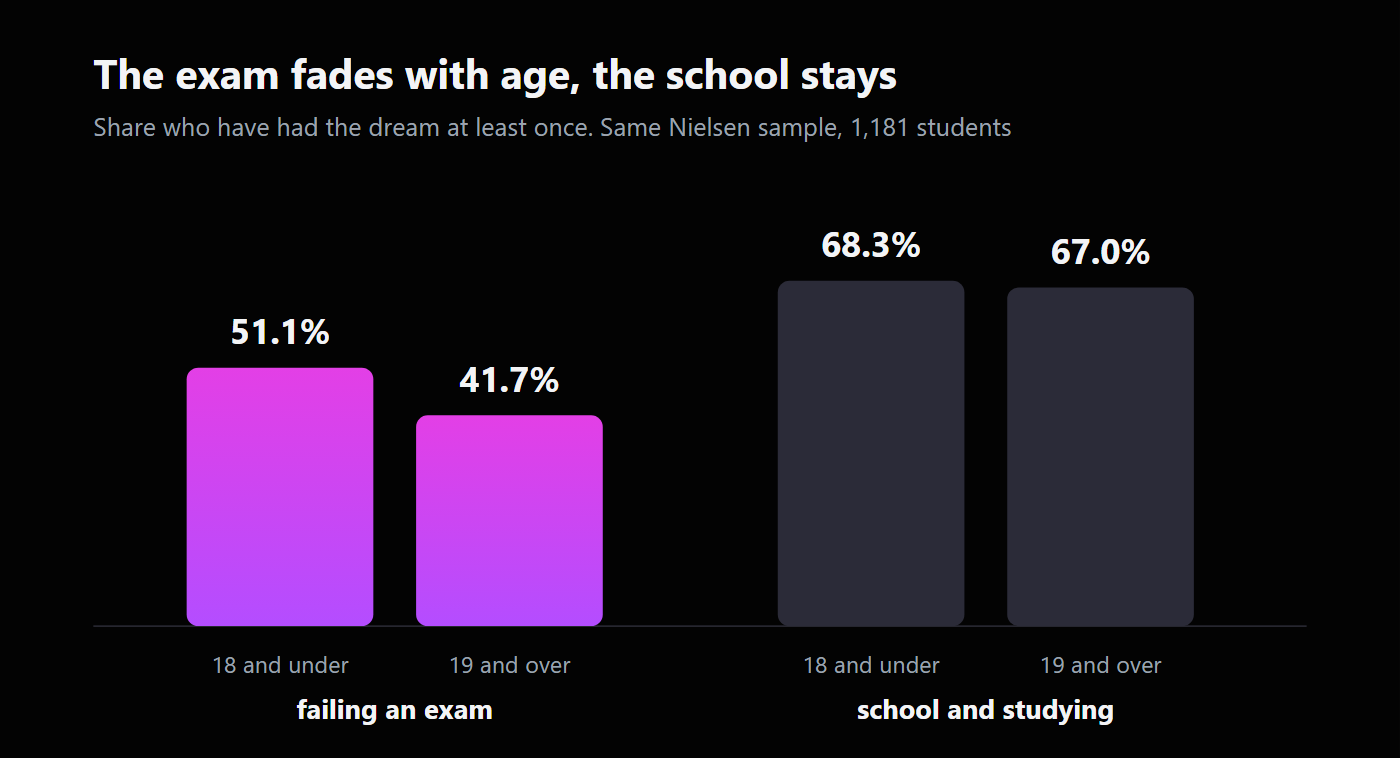
The specific plot about failing thins out once the years of regular examinations are over, while the space where a good part of early life was spent does not leave the dreams. Granted, "19 and over" in Nielsen still means students, and about people of forty that table says nothing.
The question it puts to the adult dreamer is the same one regardless: why, many years after the last test, are you hunting for a room again and sitting down in front of an unfamiliar paper.
Why the brain reaches for the school scene
The most robust thing known about dream content is that it is assembled out of waking concerns and preoccupations. A night-time story is under no obligation to repeat a daytime event literally. You may not have studied for twenty years and still live in a situation where something is expected of you, where your work is held against requirements and you have to show what you are capable of.
School supplies a ready-made form for exactly that, because for most people it is the first place where they were assessed regularly and by stated rules. Memory takes the familiar scene and drops the new test into it. This is an interpretation rather than a measurement, because why one particular adult dreamed one particular school plot is a question none of these surveys asked.
The search for a single final meaning in this dream began long before questionnaires and deans' offices. Freud discussed examination dreams in The Interpretation of Dreams in 1900 and read them as consolation, ведь the dream recalls an ordeal that was in the end passed. In 1909, citing Wilhelm Stekel, he added that such dreams concern examinations a person has already sat and passed. Over the years that followed his own reading shifted several more times.
Several meanings from one author make a fair argument against the plot having a single right one.
The night holds no forecast, and the attachment it does hold is personal, since the plot is shared by everyone, and what stands behind it differs every time. What that is becomes visible through the repeats, because when the same scene arrives a second and a third time, there is something to line it up against, in the days it landed on.