 Alisie
Falling Dreams
The stair isn't where your foot expects it. Your body knows before you do, and then you're going down. You jerk. You grab a fistful of sheet.
Almost everyone has been there, and almost nobody can say what actually happened. Did something wake you as you drifted off? Did you dream the fall and wake from it? Was the jolt the dream, or the thing that ended it?
Three different questions, and they don't share an answer. Here's what happens in the body, where the setting comes from, and why nobody else's falling dream looks like yours, with no dream dictionary involved.
The most ordinary of the strange dreams
Falling has a reputation it doesn't deserve, rare, ominous, a sign something's wrong with you. Ask a thousand people which dreams they've had at least once, though, and falling lands third out of fifty-five themes, claimed by 73.8% of them. Only being chased and sex dreams rank higher (Nielsen, 2003). Flying, the dream everyone assumes is the common one, comes ninth, at roughly half the rate.
Go off a cliff at night and you've joined a very large club.
Two things, one word
The word "falling" covers two separate events, and one night of it won't tell you which you had.
The hypnic jerk comes first. You're not asleep yet. Your muscles are letting go, and something kicks: a leg, an arm, occasionally all of you. It feels like missing a step in the dark. The whole thing takes a fraction of a second, and a minute later you can't swear it happened.
The falling dream is the other one. By then you're in REM, your body locked down by the atonia that comes with the stage. Inside the dream you're off a roof, over an edge, dropping down a lift shaft, and there's a whole situation around it: a place, a feeling, a before and an after. Whether you wake or ride it out is a coin toss.
The distinction runs deeper than it looks. A jerk fires from the brainstem while you're still crossing over into sleep, and it has no story in it because the cortex hasn't started telling one. A falling dream is the dreaming brain at full tilt, building a place and putting you in it.
Which is why the jerk is a dead end and the dream isn't. One is plumbing, on the order of a hiccup. The other has content, and content can be read.
Why the body kicks
Falling asleep, your muscles slacken. At some point the brainstem, old machinery running reflexes that predate any of your thoughts about them, takes that slackening for a loss of support and answers the only way it can. The motor nuclei fire, EMG catches the burst, your leg kicks.
None of this is a problem. Most people get hypnic jerks; some monthly, some nightly through a bad stretch of sleep. They say nothing about your nerves. The handoff into sleep just went quicker than the brainstem could keep up with.
Why it arrives as falling is less settled. One popular story traces it to sleeping in trees, the loosening muscles read as a branch giving way. It's a good story with nothing behind it, and either way the jerk stays what it is, a single twitch with no cliff, no roof, no plot.
Cliffs and roofs belong to the other kind of falling. And that raises the better question of where the brain finds them.
Where the setting comes from
Falling dreams rarely happen in a featureless void. There's usually something there: a ninth-floor balcony, the end of a pier, the lift shaft of a building you moved out of five years ago, the bridge you cross every day with its railings gone. Some people fall through a darkness with no walls and no floor, which counts every bit as much. And plenty of people keep nothing but the drop itself, with no surroundings at all, which is just as ordinary.
Where a setting does survive, though, it usually turns out to be borrowed. The brain builds these falls out of places that could actually drop you, and that you've stood in awake, the stairs you've taken a thousand times, a window, a cliff edge from one holiday years ago.
The likeliest explanation is the continuity hypothesis. Dreams don't invent their material or bury it under universal symbols. They assemble it from your days. Hall and Van de Castle established this by content-analysing thousands of dream reports in the sixties, and Domhoff extended it across decades of journals. What shows up at night tracks the concerns, places and people of one particular waking life (Domhoff, "The Scientific Study of Dreams", 2003, and Hall & Van de Castle, 1966). Worth noting that the research measured concerns far more than scenery, so "the brain borrows your places" is a reasonable extension of the finding rather than the finding itself.
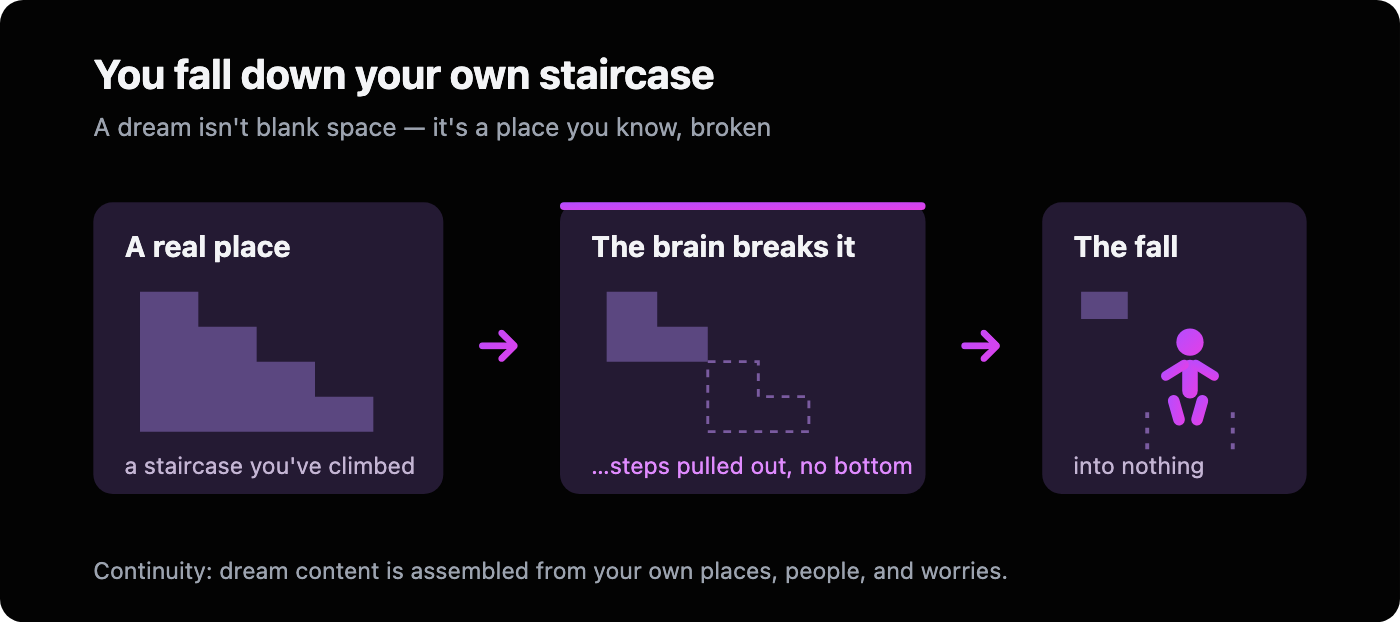
Yours is yours alone. Forget the archetypal cliff: one person goes off the fire escape they used to smoke on at sixteen, another down the lift shaft at a job they've had three years, a third from the pier where they stood last July.
So the meaning is yours too. A dream dictionary will tell you falling means losing your footing, losing control, fearing failure. But a personal setting makes for a personal reading. A school roof and an office lift shaft are two different dreams, whatever they share on paper, built from different material, hooked into different corners of a life.
The plot means something, and means only that. Domhoff is careful here: dream content comes from your day and your worries, full stop. Nothing waits behind the symbol, because there's no symbol. That balcony reads literally: a familiar place, run in a mode where gravity works and the railings have quietly disappeared.
Patterns across people are thinner than you'd hope. Nobody has broken falling dreams down by setting, whether cliff, roof, lift or stairwell, and nobody has coded how the falls end, either.
Which leaves you comparing your third night in a row against your own previous ones, because there's no benchmark to compare it to instead. That's why Alisie lets you search old dreams by keyword, filter and tag. Pull up every fall you've recorded and see what keeps showing up in them.
Do you die if you land?
The story has been recycled for decades. Hit the ground in a dream and you die in your sleep. Softer version, you always wake up a moment before impact.
Both fall apart on contact with anyone who's landed. People hit the ground, wake up fine, and tell you what happened next. Some wake before impact, some after, some stay asleep straight through it.
The research goes somewhere stranger. Dreams of your own death turn out to be a stable category of their own, and their tone is more often peaceful than terrifying. Over half of them keep going past the moment of death, cutting to a scene where the dreamer watches from outside it (Barrett, "Dreams of Death", OMEGA, 1988). Accounts vary, some people become a ghost, some end up in an emptiness that holds nothing except themselves, still thinking, still following along.
Landing, it turns out, is a plot point. And there's nothing in it to fear, because REM keeps your muscles offline, so whatever the dream does, it isn't doing it to your body.
What to do with one
Two candidates, then: the twitch at the threshold, and the dream where you're going off an actual roof. One night won't sort them for you. A jerk might be a jerk and gone by morning, or the opening of a run that turns into a proper falling dream a week on. Or it might not.
A single vague fall, no setting, nothing you could point to on a map, is most likely plumbing, the brainstem twitched, the body answered, and the dream never got as far as building anything.
A fall that keeps coming back is different. Same courtyard, same cold spot under the ribs, and now you're looking at a plot that belongs to you. Why your brain keeps reaching for the same material is a question only you can answer, and no dictionary is going to shortcut it.
Domhoff calls the underlying thing the repetition principle. Dreams that recur aren't noise, they're caught on something in waking life. Finding out what takes having something to reread, which means writing the fall down as "off the fire escape in the courtyard, railings missing, cold under the ribs, woke halfway down" rather than "weird one again". Do it straight away, before memory starts rewriting. The setting fades first, by evening the drop is still vivid and the place around it is gone.
Keep the journal to watch rather than to decode. Does it come back, in what place, with what feeling, in which week of your life? A month or two in, either something surfaces or it doesn't, and both are worth knowing.
Falling is one of the easier dreams to track this way, concrete, physical, and it stays whole in your memory. Write it down while you can still say where the ground went.