 Alisie
Why Vivid Dreams Follow a Week of Short Nights
You spend the week getting up before you want to, then sleep in on your first free morning, and the night lands differently. The dreams run long and detailed, the imagery stays sharp, and far more of it survives into the morning than usual.
The same thing shows up after you skip your evening drink, when you come off an antidepressant, or on a first night of CPAP therapy for apnea. REM sleep is tracked on its own ledger, separate from your total hours. Take it away and your brain will give the stage more room the moment it can. That payback is called REM rebound.
REM keeps its own ledger
Cut your sleep short and you don't lose a bit of everything. Deep sleep is largely protected, and it's REM that goes, which is why a run of short nights changes what your sleep is made of more than how long it lasts.
A normal night gives REM 20-25% of total sleep across four or five periods, and those periods stretch out as morning approaches. That puts the weight of your REM at the end of the night, exactly where an alarm cuts it off.
While the stage is being withheld, attempts to enter it grow more frequent, and once the restriction lifts, the size of the payback tracks the size of what was lost.
William Dement watched this happen first, in 1960, with a method that left nothing to interpretation: for five nights running, every time the recording showed REM beginning, he woke the sleeper. What made the point wasn't the deprivation but its cost, namely holding someone out of REM took more awakenings each night as pressure for the stage built.
The week took a toll. Participants turned irritable and anxious, and several dropped out before it ended. When the awakenings finally stopped and they were allowed to sleep, REM claimed 26.6% of their sleep, up from 19.4%.
Dement had shown the stage reclaims its lost minutes. Whether the dreams inside those minutes changed too was still an open question.
The minutes come back, and so does the intensity
Tore Nielsen and colleagues answered that in 2005 in Sleep. Twenty-seven healthy volunteers, 14 women and 13 men aged 18 to 41, spent three nights under polysomnography, and half of them were woken at the threshold of REM on the second night, before the stage could open up. On average those sleepers got 4.68 minutes of it at a time; the control group ran 23.9 minutes undisturbed.
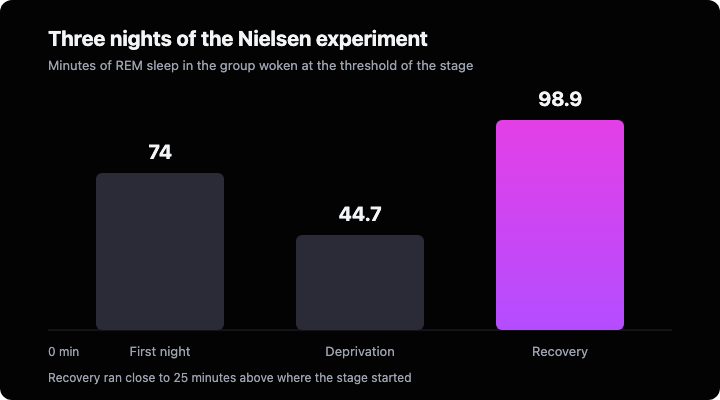
Recovery didn't stop at the baseline. In the deprived group REM ran 74 minutes before the intervention, compressed to 44.7 under the awakenings, then opened out to 98.9 minutes, close to 25 minutes above where it started. The control group gained a single minute over the same span, or 3.58%.
The authors called the rebound modest. Alongside it they asked participants to rate, on a nine-point scale, how dreamlike the experience had been at all: the deprived group averaged 6.31 against the control group's 4.46.
More than minutes had come back. The dreams read more like dreams, imagery that held its shape, scenes that followed one another instead of scattering, and it was the sleepers themselves who reported it.
The effect reached past the recovery night. The loose imagery that arrives on the edge of falling asleep the following evening had grown more dreamlike too.
You can see the intensity within the stage itself. The denser the eye movements, the more vivid and eventful the report. That's two measures moving together, not evidence that the eye movements put anything into the dream.
A sleepless night does the opposite
If the deficit accumulates, a night with no sleep at all should hand back the most dreaming of any, and it does the opposite. Luigi De Gennaro and colleagues kept 40 healthy participants awake for 40 hours in 2010, and after the recovery sleep that followed, morning recall had dropped by roughly 75%.
The night genuinely was different, more deep sleep, fewer spontaneous awakenings, and less REM than a normal night. Sleep debt gets repaid in order, and deep sleep is first in the queue.
Wake less often and you lose the moments where a dream catches hold in memory, and without them there's little left by morning, however long you slept. Vividness comes from a night cut short at the end, not from a night skipped altogether.
Both mornings leave the same impression of something unusual, and only what you wrote down tells them apart. After a rebound there's a lot to write down, the plot runs long, there are several scenes, and half of it slips away while you're still looking for the words. Alisie lets you set up a template for nights like that, the people who show up in your dreams most often, the places you keep returning to, your usual tags, already filled in when you open a new entry, so the morning is spent adding what was different this time.
What else takes the stage away
An alarm clock cuts into the last hours, where REM periods run longest, but plenty of things you'd never connect to dreaming take the stage away just as effectively.
Alcohol shortens the time it takes to fall asleep, consolidates the first half of the night and wrecks the second. It suppresses REM in proportion to the dose. A systematic review of 27 studies puts the threshold at roughly 0.50 g/kg, about two standard drinks, with the disruption growing from there. Which is why the first nights after dropping an evening drink can turn surprisingly rich, because the stage gets its time back after a stretch of being pushed down.
Antidepressants work much the same way. Most of them suppress REM, and coming off a serotonergic drug lets the stage rebound. Vivid dreams and nightmares count among the standard withdrawal symptoms alongside insomnia and hypersomnia, and they're part of what distinguishes withdrawal from the illness returning. They usually turn up in the first week and clear within two to six. Any decision about stopping belongs with your doctor, because prescribed treatment isn't something to drop on your own.
Apnea makes the clearest case of all. Breathing interrupts REM for years while the sleeper has no idea it's happening. Start CPAP therapy and the restriction lifts all at once. Rebound shows up on that first night in 23-46% of patients, with REM duration jumping 57% against the diagnostic recording. Those figures come from a 2017 systematic review by Nigam, Camacho and Riaz covering 14 studies, 11 of which found a significant increase.
What predicted the rebound was how little REM a patient had been getting beforehand, namely the less the diagnostic study recorded, the more likely the stage was to surge on that first treated night. Different causes, one pattern, the stage is squeezed, then it takes back what it can.
What you can actually tell from your own nights
A rebound plays out over a single night, which is exactly why one night can't reveal it. What happened to your sleep stages is something lab equipment reads; a memorable dream on its own says nothing about it either way.
What's legible is a run rather than a night. A week where REM is consistently short, then the restriction lifting, then sleep that differs in both length and density, and that's the sequence the lab was catching.
Physiology accounts for the force of the impression here, not for what you dreamed. It answers why the night stood out, and says nothing about who turned up in it or what you were carrying that week. The dream is still assembled from your memory and your life, and the rebound leaves that part alone, and it only gives it more room and more definition.