 Alisie
What Screen Light at Night Does to Your Dreams
Evening screen light takes more from your night than sleep time. It cuts into REM, the stage that supplies almost everything you later recall as a dream. In one lab study, four evening hours of tablet reading cost participants around twelve minutes of REM and pushed the onset of melatonin release back by nearly an hour and a half. The colour of the screen isn't what does it, because warm-tint modes that leave brightness alone showed no advantage in the research.
Evening light shortens REM, where the dreams live
The morning "I didn't see anything" starts hours before you wake, at the moment you take your phone to bed.
That was measured in 2015. Twelve people spent two weeks in a sleep unit, reading either from a tablet or a printed book between six and ten each evening. After the tablet, melatonin was suppressed by half and its onset shifted by nearly an hour and a half. Falling asleep stretched from fifteen minutes to twenty-five, and the night held roughly 110 minutes of REM instead of 120.
Twelve minutes is about a tenth of a night's REM, and it comes out of the stage dreams are carried from: woken from REM, people produce a full dream report 81.9% of the time, against 43% when woken from slow-wave sleep. The imbalance is an awkward one, namely what gets trimmed is the very stretch of night a detailed report tends to survive.
Whether those twelve minutes show up in the morning nobody has measured, because dreams weren't collected in that experiment. And the link runs less directly than you'd hope. In a large 2025 study, REM proportion on its own didn't predict recall at all. How you wake mattered more than how much of the stage you accumulated. Worth remembering the sample too: twelve people, and a demanding condition of four unbroken hours with a tablet.
It takes less light than you'd think
The human threshold sits well below what intuition suggests, and that was established back in 2000 with twenty-three volunteers exposed to a range of intensities in the early biological night. Half of the maximum effect, for melatonin suppression and for the shift in the body clock alike, arrives at around 100 lux, and the whole span from no response to full response fits between 30 and 300 lux.
Now the same figures for a phone. In a dark room, at arm's length, at full brightness, a screen delivers 25 to 60 lux depending on what's open on it.
An ordinary phone in the dark sits squarely inside the range where the response is already underway. The impression that "it's practically dark in here" counts for little. What matters is the actual illuminance, not how it feels.
The spread between people runs fifty-fold
Sensitivity to evening light varies enormously among healthy people. In 2019, fifty-five participants spent five evening hours at different light levels. Across the group, melatonin dropped by half at around 30 lux. Behind that average sits the spread, the most sensitive participant needed 6 lux, the least sensitive 350, a difference of more than fifty times.
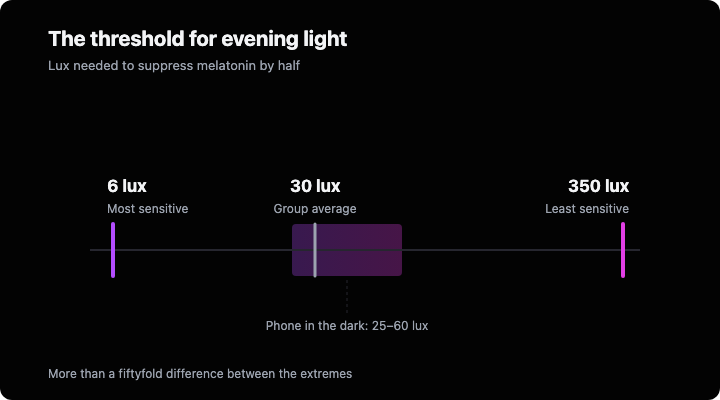
Both extremes turned up in healthy people with no sleep disorders, and what separated them was physiological sensitivity to light rather than how they lived.
It's the amount of light, not the blue
The idea that shifting the screen towards warmer colour is enough has been tested and didn't hold. In 2019, twelve people looked at a tablet from 11pm to 1am across four separate nights, with two of the four conditions being night-shift modes at different colour temperatures. Melatonin suppression between those two modes didn't differ significantly. The authors' conclusion, changing a screen's spectrum without touching brightness may not be enough.
Blue-blocking glasses tell a similar story. A 2025 meta-analysis pulled together three randomised trials with objective measurements, and on none of the outcomes, sleep onset, total sleep time or sleep efficiency, did the difference reach statistical significance. The authors rated the certainty of evidence as low, and a 2023 Cochrane review reached the same verdict, namely the convincing data isn't there.
A warm tint at full brightness is still bright. What counts is the quantity of light reaching the retina, and a colour filter on its own doesn't reduce it.
Waking at night is the worst moment for a bright screen
The same screen hits differently depending on what your eyes have been doing beforehand. In 2011, researchers compared night-time light exposure after several hours in very dim conditions against the same exposure after ordinary room lighting. After the dim conditions, both melatonin suppression and the phase shift came out markedly stronger. An eye that has settled into darkness reacts more sharply.
Three in the morning, you surface holding a fragment of a dream, the room has been dark for hours. The screen delivers its 30 to 50 lux into eyes tuned for darkness, and waking from REM in the last third of the night gives the best odds of recalling a dream, so the timing is exactly right.
Leaving it until morning won't work, because a dream's content fades within minutes, and by dawn a night-time fragment is usually gone. The question isn't whether to record it but how much light that will take. In Alisie you can dictate it aloud without turning the screen on at all, and the recording is still there in the morning, and the details can be reconstructed from it. Dictation can also be triggered by a Siri command, so a single spoken phrase is enough at night.
No study has looked at this exact situation, and sensitivity after darkness and screen luminance were measured separately, never together.
Brightness matters more than colour
If the choice is between changing the colour and lowering the brightness, the data supports the second. In the same study that measured screen luminance, dropping brightness below eighty percent of maximum in a dark room brought calculated melatonin suppression under 2.3%. Calculated, meaning derived from a model rather than measured in people. A dark interface works in the same direction, simply because fewer pixels are lit, though no reliable measurement of how much exists, so putting a number on it would be dishonest.
There's a second way a screen shortens a night, unrelated to light. In large observational datasets, every additional hour of screen time is associated with 3 to 5 minutes of lost sleep and a bedtime around 13.2 minutes later. That's an association rather than demonstrated causation, but it concerns time rather than lux. Brightness comes down with a single swipe, whereas neither a dark theme nor night mode does anything about the hours a phone takes.