 Alisie
Why Freud's Dream Theory Did Not Survive Testing
You woke from an odd dream, went looking for what it meant, and the first thing you hit was Freud. A snake stands for sex, falling dreams for a repressed wish, an unpleasant plot for punishment over something you will not admit. It is the same logic dream dictionaries sell, except that Freud built it into a full theory and gave it a method. Then dreams became something you could collect and count, and no independent evidence for what he promised turned up in them, no disguise, no censor, no universal key. One thing survived, and it is the important one, dreams really are assembled out of your life. They just say so plainly.
What Freud Actually Promised
In The Interpretation of Dreams he proposed treating a dream as a disguised wish fulfilment. Inner life reaches you by a detour, because latent content passes through the dream-work and comes out as the plot you remember in the morning. Condensation, displacement and visual representation do the converting, and a censor supervises the whole business so that nothing unacceptable reaches consciousness in its original form.
The book appeared on 4 November 1899, though the title page said 1900. Franz Deuticke printed the first edition in Leipzig and Vienna in a run of 600 copies, and it took eight years to sell. Seven more editions came out in Freud's lifetime, the last in 1929, and over those three decades a private Viennese doctor's hunch turned into the common language people still use about dreams.
Freud called dream interpretation the royal road to the unconscious. You were meant to travel it backwards. The dreamer supplies free associations, the interpreter supplies symbols, and out of the remembered plot comes whatever the theory says is hiding behind it. A dream had a second job as well - it guarded sleep. The disguised wish was not supposed to wake you.
It is a strong promise, and its neatness makes it easy to miss how much you have to grant. A dream must have a second, real text, a mechanism must exist that turns one text into the other, and somebody must hold the dictionary for translating back. All three are testable, and not one of them passed.
The First Crack: Nothing Could Prove It Wrong
The crack opened long before sleep laboratories, because it was built into the design. If a dream did not show a wish outright, the censor was to blame. And when no suitable wish could be found in the dream at all?
The theory had an answer ready, which was that the disguise had simply worked harder. Freud later added punishment dreams, in which the wish being fulfilled is an unconscious wish to be punished for a forbidden one. Counter-wish dreams followed, where an unpleasant plot was declared the satisfaction of a masochistic streak. In one case Freud explained a patient's unpleasant dream as her wish to prove him wrong, and objecting to the theory became a way of confirming it. His own readings drifted as well, and dreams about exams are the clearest case, since he revised what they meant more than once.
The philosopher Adolf Grünbaum took that manoeuvre apart and counted several logical errors in Freud's reply at once. They come down to one thing, that every objection got absorbed into the system. A dream confirms a wish and the theory works, and if a dream contradicts it, then the censor, the punishment or the counter-wish is working instead.
Karl Popper later used psychoanalysis as a whole as the textbook case of an unfalsifiable, and therefore unscientific, system, and dream interpretation falls under the same diagnosis. For you that has a plain and unwelcome consequence. If a theory explains a dream with a wish and a dream with no wish equally well, then no interpretation of your dream can be confirmed or refuted. The interpreter is always right, and you never find out whether he actually was.
Dreams Became Countable, and the Disguise Was Missing
Everything changed in 1953, when REM sleep was discovered. You could now wake someone inside that stage and take down the account while it was still fresh. Dreaming stopped being only a thing to interpret and started being collected.
In 1966 Calvin Hall and Robert Van de Castle published a coding system for dream reports, and accounts could be sorted into categories, counted and compared across age, sex and culture. Freud's theory had acquired an opponent made of numbers.
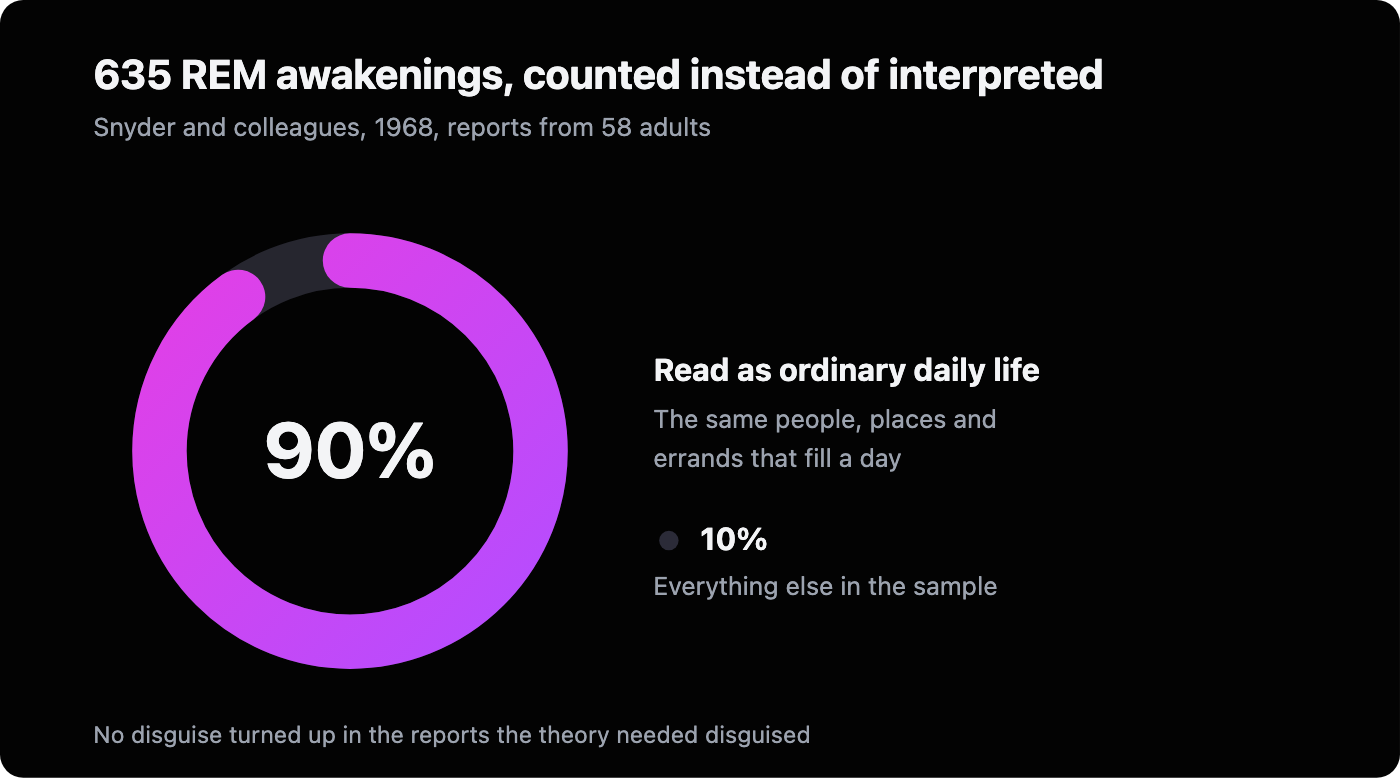
Snyder and colleagues ran one of the first tests in 1968. Out of 635 REM awakenings from 58 adults, 90% of the reports would have passed as credible descriptions of ordinary daily life, with the same people, places and errands that fill a day. If dreams are ciphers, the cipher turned out to look suspiciously like plain text.
The method of free association got tested too. In Walter Reis's study, published in condensed form in 1959, 24 students supplied series of ten dreams each, and personality judgements made from the dreams alone broadly matched the judgements raters reached once they also had the free associations. Popp, Luborsky and Crits-Christoph found something similar in 1992, comparing therapy narratives against dream content. The samples are small and neither study settles much on its own, but they converge in an awkward direction for the theory: if adding free associations barely moves the conclusion about a person, the associations do not look like a necessary tool for decoding hidden content.
Foulkes and colleagues showed in 1988 that dream emotions match dream content. On Freud's account the dream-work distorts the plot while leaving the feeling untouched, and in practice the feeling fits the plot, with no gap between them where a distortion could sit.
There is a blunter test still. The Hall and Van de Castle normative sample of 1966 was built from a hundred men and a hundred women, five dreams each, 1,000 reports in all. The sexuality category showed up in at least one dream for 12% of men and 4% of women. That alone does not refute Freud, since a repressed wish is not required to surface openly by definition, but it does not give the independent confirmation a theory driven by repressed sexual wishing would want, and the disguise that would account for the gap has never turned up.
Children Showed That Dreaming Has to Grow
The most awkward place for the theory is children's dreams. David Foulkes and colleagues followed children aged 3 to 15 in a sleep laboratory for several years. 26 of them stayed the full five years, another 34 for at least three, and 43 for at least one, coming to 2,711 awakenings in all.
Up to age nine, only 20-30% of REM awakenings produced any dream report, and by ages 9 to 11 the median rose to 79%. Reports from children under five were rare, short and static.
Until age eight the plot of a dream stayed very simple, and the child was more often watching the dream than acting in it. Acting in your own dream starts around ages 7 to 9, and that is also when reports from other stages pick up, with non-REM awakenings yielding 6% at ages 5 to 7 and 39% at 11 to 13.
That sequence sits awkwardly with Freud's picture. He offered simple children's dreams as the purest case of wish fulfilment, which invites the expectation that small children ought to dream most freely and most often of anyone. What the laboratory shows instead is a capacity slowly maturing: the youngest children barely report dreams at all, and what they do report are short motionless pictures, with the frequency only approaching adult levels by ages 9 to 11. Foulkes has a duller and far better supported explanation, which is that dreaming is a capacity, and it grows along with the child, along with imagination and speech.
What Freud Conceded and What Survived
One serious exception Freud conceded himself. In Beyond the Pleasure Principle in 1920, reflecting on war neuroses after the First World War, he ran into recurring traumatic dreams that neither fulfilled a wish nor guarded sleep. For those he introduced repetition compulsion and rebuilt the theory around a mechanism that fits neither of the original functions.
It did not stay a peculiarity of one war. Research on Vietnam veterans showed how durable a traumatic dream can be: the same heavy plot can keep coming back for years, and censorship will not account for that. Repetition here looks like a durable property of the content itself, and bad dreams that keep coming back are a subject of their own, since nightmares turn on how often they arrive rather than on what they conceal.
One early idea of Freud's did outlive his entire system of symbols. Dream content is tied to a person's life, and the tie is not arbitrary. His observation about the day residue held up and got sharper, since Tore Nielsen and colleagues showed that events from the day right before a dream turn up in it more often, and a second peak appears roughly five to seven days out, the so-called dream-lag effect. Out of that connection grew the continuity hypothesis, on which dream content reflects a person's waking conceptions and emotional preoccupations. It is the most solidly established finding in the field.
Counted honestly, that is not nothing. Dreams really are about your life, they really do pick up what the day was full of, and taking them seriously turned out to be the right instinct. What failed is the instrument Freud brought to them.
The live argument now is a different one, over how much of this rehabilitates Freud himself. Mark Solms showed in work published in 1997 and 2000 that focal damage to the medial frontal lobe and the temporoparietal junction can end dreaming while REM sleep continues, and that damage to the pons can leave dreaming intact. Solms links the dopaminergic pathway that drives dreaming to Freud's drives and interprets that evidence as compatible with the motivational half of the theory. William Domhoff answered him in 2004, since empirical researchers parted with Freud over measurements rather than ideology. Even on the version most generous to Freud, though, what is at stake is motivation, and the disguise, the censor and the universal symbols come back in none of them.
So the personal meaning of a dream is better sought not in what a single image stands for, but in the recurring connections inside your own run of dreams. Alisie works as an encyclopedia of your own dream world, where you write your own lore night after night instead of looking it up in somebody else's table of meanings. No artificial intelligence invents that world for you, because you are the one who built it.
What Science Put in Place of Interpretation
After a century of research what sits at the centre is one person's series of dreams. Domhoff notes that evidence for symbolism in dreams is very slight or absent, and something else moved into the vacated space. In laboratory-collected reports dreams mostly read as coherent and reasonable simulations of the real world, held together by people, relationships, events and the concerns of waking life. There is meaning in dreams, and it sits in the open.
You see it already in your own run of dreams, not only in research archives, which is why remembering your dreams is the step everything else waits on. In the dream journals Domhoff has studied, the same handful of themes kept accounting for a substantial share of the content, and the rise and fall of aggressive and friendly exchanges with particular characters in a dreamer's dreams tracked the rise and fall of those same relationships in waking life. What returns is the theme more than the picture, and none of it needed decoding, only counting.
This is also the answer to the question you started with. There is no universal dream dictionary for the reason that there is no universal dreamer, and that is the load-bearing finding in the psychology of dreams. A dog in your dream drags along the dog you grew up with, and in mine the one that bit me. The image is the same, what stands behind it is not, and the meaning comes out of the same place the image came from, your life and your own run of dreams.
Freud was right in the original observation, since dreams are tied to your life and do not come out of nowhere. He was wrong about the explanation, because no censorship and no pre-set symbols for decoding that tie were ever found in dreams. What science found instead is that a dream carries your life on inside the dream. The meaning of a recurring image comes out of a long series of your own dreams, and it reads best back where it came from, in your own life and your own run of dreams.