 Alisie
Why You Have Nightmares and How to Stop Them
Nightmares are something almost everyone has, since roughly 85% of adults have at least one in any given year, and having them now and then means nothing is wrong. They're a normal part of how the sleeping brain works, a vivid, frightening dream, usually in REM sleep, that tends to wake you in the last hours before morning. Mostly they track what's going on in your life, stress above all, and they fade as it passes. Only when they come often enough to make you dread sleep do they cross from ordinary into something worth acting on, and even then there's plenty you can do about it. Below is why nightmares happen, how often is actually a lot, and what helps.
What Counts as a Nightmare
A nightmare is a disturbing dream, usually charged with fear, dread, or anxiety, that typically wakes you, leaving you alert and able to recall what happened. That last part matters, because it's what separates a nightmare from something people often confuse it with.
A night terror (or sleep terror) looks more dramatic from the outside but works completely differently. It happens in deep non-REM sleep, in the first third of the night, and the person may sit up, scream, or thrash while still asleep, then have little or no memory of it in the morning. Nightmares work the other way round, since they come later in the night, out of REM, and you wake up and remember. The simple test: if you woke, recall the dream as a story, and it happened toward morning, that was a nightmare. If it struck early, the sleeper barely woke, and nothing is remembered, that points to a night terror, most common in children, and a different phenomenon with its own causes.
A third state gets mistaken for a nightmare too, sleep paralysis. You wake up aware but unable to move, and it lasts anywhere from a few seconds to a couple of minutes, sometimes with a heavy sense that someone else is in the room. It's frightening, but what's happening is mundane. Your muscles are switched off during REM so you don't act your dreams out, and here your mind has come back online while that shutdown is still lifting. The tell is simple, namely a nightmare is a dream you watch and then wake from, while paralysis finds you already awake and unable to move. It passes on its own.
Why Nightmares Come Just Before Morning
Nightmares happen mostly in REM sleep, the stage where the brain is most active and dreams are most vivid. REM isn't spread evenly across the night. It comes in periods that get longer with each roughly 90-minute cycle, so the longest, most intense stretch of REM falls in the last couple of hours before you wake. That's why a nightmare so often is the thing that wakes you in the early morning, because you're surfacing out of the night's deepest dive into REM.
Why the brain produces frightening dreams at all is less settled. One leading idea is that dreaming helps process emotions and fear memories, a kind of overnight regulation of the day's emotional residue, and that nightmares are that system running hot, or failing to turn the fear down as it should. This is a reasonable and actively researched hypothesis, not an established fact; treat it as the current best guess rather than a proven mechanism. It's also worth knowing that ordinary dreams already skew fearful and anxious, and the psychology of dreams covers the emotional baseline nightmares sit at the far end of. What is well established is more useful anyway, namely the triggers that make nightmares more frequent, and what to do about them.
What Triggers Nightmares
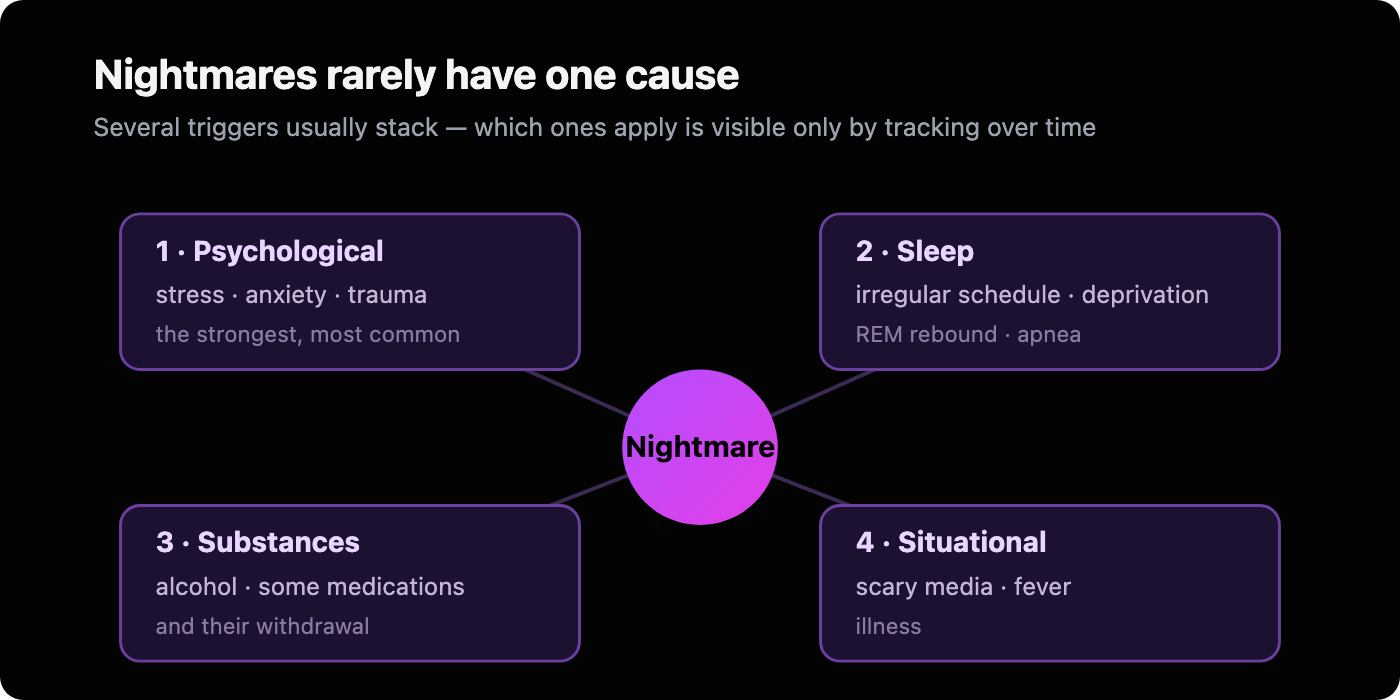
Nightmares rarely have a single cause. For most people several factors stack, and which ones apply is often only visible by tracking them over time. The most consistently reported triggers:
Stress and anxiety. This is the strongest and most common association, and part of a wider shift stress works on your dreams. Periods of acute stress, and anxiety disorders generally, reliably raise nightmare frequency. A clear illustration: during the COVID-19 pandemic, several studies recorded a jump in frequent nightmares, in some samples close to a doubling, as collective stress rose. Nightmare frequency tends to track what's happening in your waking life.
Trauma. Nightmares are a hallmark symptom of post-traumatic stress disorder, where they're often recurrent and replay elements of the traumatic event. Trauma-related nightmares are also the ones with the most-studied treatments, which is partly why the research on nightmares is as developed as it is.
Poor or irregular sleep. Being overtired, keeping an erratic schedule, and fragmented sleep are all linked to more nightmares. Part of the mechanism is REM rebound: when you've lost REM sleep, through deprivation, alcohol, or stopping certain drugs, the brain later compensates with a surge of extra REM, and more REM means more opportunity for vivid, disturbing dreams.
Alcohol. Drinking, especially heavier drinking, suppresses REM early in the night; as it wears off, REM rebounds, which is why a night of drinking can be followed by intense dreams or nightmares in the early morning.
Medications. Several drug classes are linked to nightmares: certain antidepressants, some blood-pressure medications (beta-blockers among them), and some Parkinson's drugs, and so is stopping certain medications, again through REM rebound. This is worth raising with a doctor if nightmares started after a medication change. It is not a reason to stop a prescribed drug on your own.
Other contributors show up too, untreated sleep apnea is associated with nightmares, and treating it can reduce them; frightening media before bed, fever, and illness are common minor triggers, and dreams during a fever do rate bleaker than ordinary ones, though they are not always nightmares. The practical point is that these overlap and vary from person to person, and the only way to know which are driving your nightmares is to notice what they coincide with.
How Often Is Normal?
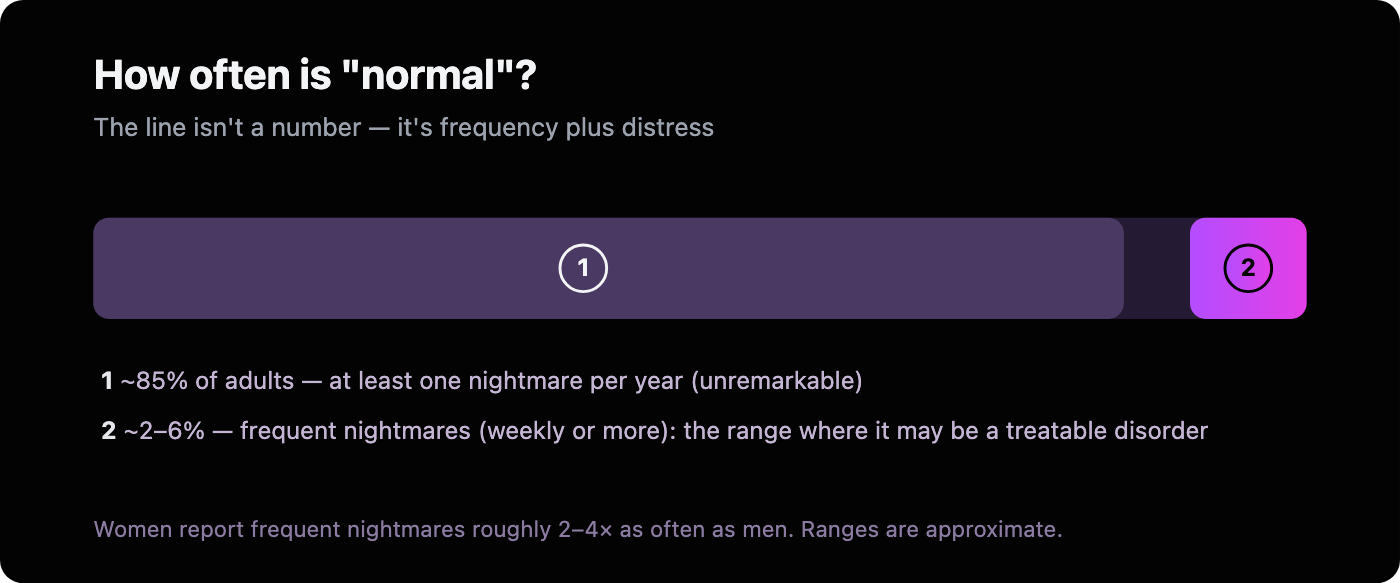
Occasional nightmares are so common they're unremarkable. Around 85% of adults report at least one in a given year. At that level, a nightmare is a normal part of dreaming, not a sign of a disorder, which says nothing about what it may mean to you, only that its presence alone is not a symptom.
Frequent nightmares are a different matter. Roughly 2-6% of adults have them about weekly or more, with community studies often landing near 5%. Women report frequent nightmares more often than men, by a ratio somewhere between two and four to one; why isn't fully clear. The threshold that actually matters clinically isn't a specific number of dreams. It's whether they're causing distress, dread of going to sleep, disrupted rest, or a low mood that follows you into the day.
This is why the single most useful first step is unglamorous: know your actual frequency. People are poor at estimating it from memory. A couple of bad nights can feel like a constant siege, while a genuinely elevated rate can hide behind "I don't really remember." Treatment and the decision to seek it both start from a real count, not an impression.
What Actually Helps
The good news is that frequent nightmares are very manageable, often without any medication at all.
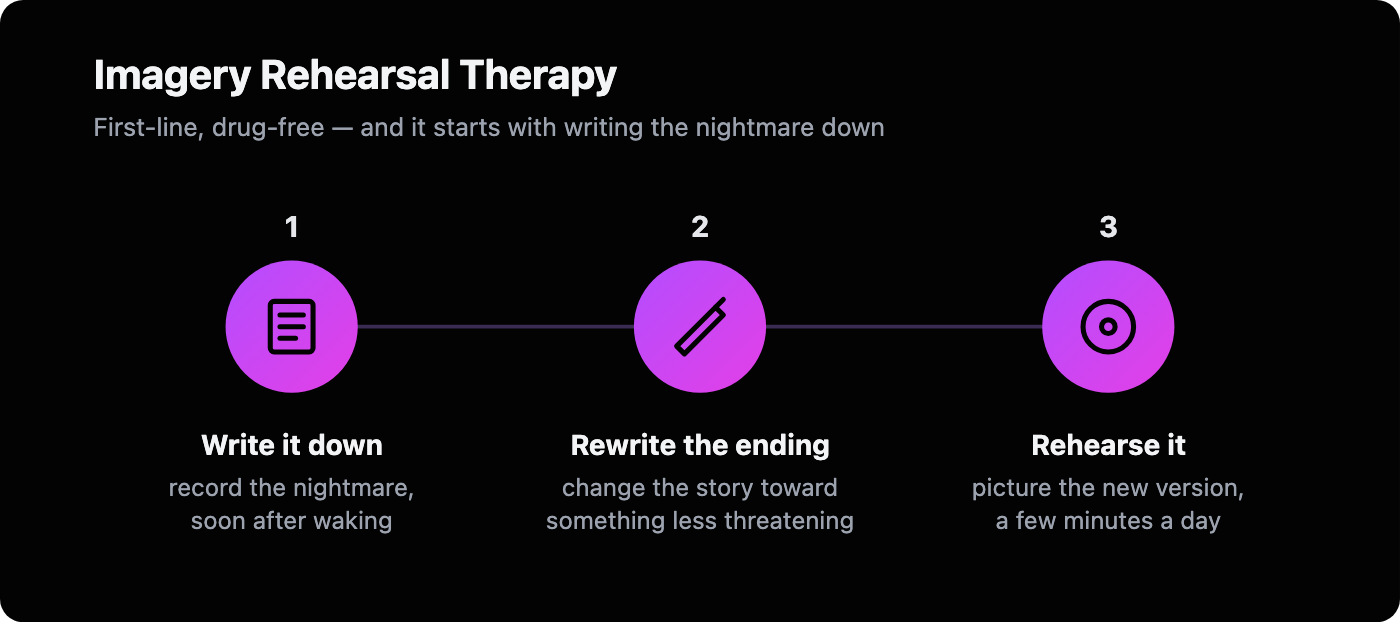
The one to know is Imagery Rehearsal Therapy (IRT), and the idea is deceptively simple. While awake, you take a recurring nightmare, rewrite its storyline toward a new, less threatening ending, and then rehearse the new version in your imagination for a few minutes a day. Over weeks, the rewritten script tends to displace the old one, and the nightmares grow less frequent and less upsetting. It's the approach with the strongest evidence behind it, the one sleep specialists reach for first, and the benefits hold for months. It isn't universal; around 30% of people don't respond. But for a brief, low-risk technique you can do at home without any medication, the track record is strong.
IRT depends on one concrete thing, namely a written record of the nightmare. You can't rescript a dream you can only half-remember, so capturing it, even a few lines soon after waking, is the raw material the method works on.
A second evidence-backed route runs through lucid dreaming. Learning to become aware inside a recurring nightmare, and then to change its course, can reduce how often nightmares happen and how much they distress you. One detail from the research is worth knowing. In a study of combat veterans, it wasn't awareness alone that helped, it was control. People who became lucid but couldn't alter the dream got little relief; the benefit came from being able to change what was happening.
Often, though, the simplest lever is the trigger itself. Regularizing your sleep, cutting late-night alcohol, and easing a stressful stretch tend to bring the nightmares down with them, which is why noticing what yours line up with is so useful. (There's also a medication, prazosin, once popular for trauma nightmares, but a large 2018 trial found it no better than placebo, so its status is now contested rather than the reliable fix it was taken to be.)
One case stands apart, nightmares that follow a traumatic event, or that come with the intrusive symptoms of PTSD, are best handled with trauma-focused care rather than on your own. For the ordinary frequent kind, the behavioral tools above are the front line.
Start by Knowing How Often They Happen
Every path through this article runs back to the same first step, an honest count. People are poor at estimating nightmare frequency from memory. A couple of bad nights can feel like a siege, while a genuinely elevated rate hides behind "I don't really remember." Whether you decide to try IRT, to change something about your sleep, or simply to watch, you need to know what "often" actually means for you.
That practical need, turning a vague sense of "too many bad dreams" into something you can see, is where a journal earns its place. In Alisie, an iOS dream journal, you can mark an entry as a nightmare, and the app keeps a running count and trend, so your real frequency becomes visible rather than guessed at. The characters, creatures, and places you note in your own entries get tallied too, which is how the repeating elements of a recurring nightmare surface across the archive. You can tag possible triggers, a late drink, a stressful day, a medication change, and see over time which ones actually track with your episodes. And because IRT begins with writing the nightmare down, that same record is the starting point for the rewriting step.
The Short Version
Nightmares are a normal REM-sleep event that clusters before dawn, and almost everyone has one now and then. They're driven less by any single cause than by a stack of triggers, stress above all, plus poor sleep, alcohol, and sometimes a medication, all of which tend to be visible only when you track them. The line between ordinary and worth-acting-on is frequency, not the mere fact of a bad dream, which is why getting a real sense of your own rate is the sensible first move. And if nightmares do turn frequent, they're among the more treatable things in sleep, a short rewriting technique works for most people, lucid-dreaming skills are a second option, and trauma-linked nightmares are worth bringing to someone who treats trauma. The one thing not supported by evidence is assuming nothing can be done.