 Alisie
Why Your Weekend Dreams Are So Much More Vivid
On weekdays your alarm can cut sleep short right when it becomes richest.
The first part of the night is mostly deep sleep. Closer to morning there is less of it, and REM periods, where vivid, story-shaped dreams tend to arise, grow longer. So anyone who gets up at the same early hour each day is regularly cutting away the same piece of the night.
Then Saturday arrives.
No alarm, you drift back to sleep after the first waking, and suddenly there is a long story, several scenes in a row, faces, places, dialogue, details that never seem to show up on a Tuesday.
After a run of short nights REM can bounce back. And by morning there is more of that stage anyway.
The alarm cuts the night off at its best part
Sleep architecture shifts across the night, deep slow-wave sleep is concentrated in the first cycles, while REM periods gradually lengthen. The first episode may last only a few minutes, while the last ones can run for tens of minutes.
An early wake-up therefore lands on the same stretch every time. It trims the closing part of the night, where REM already takes up a sizable share.
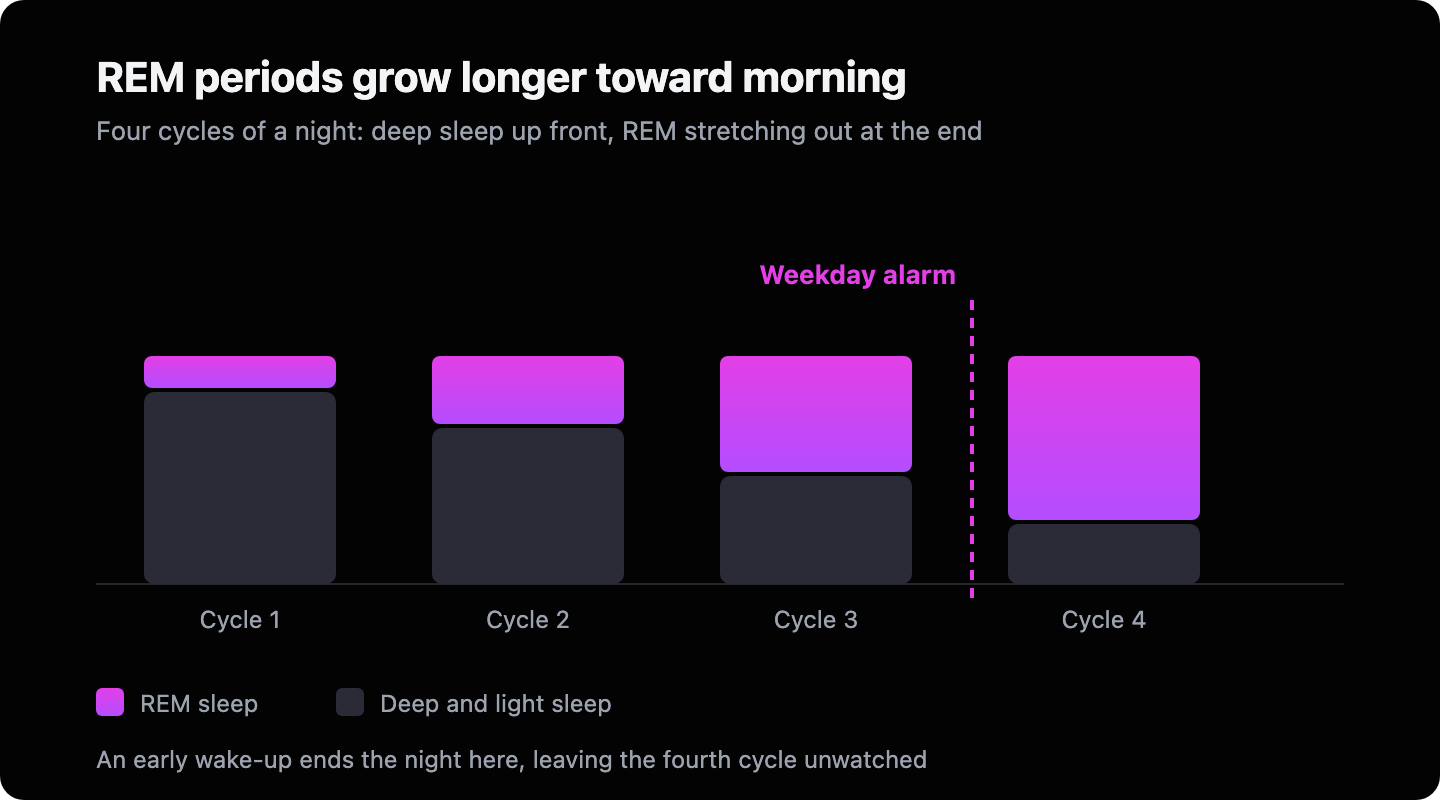
A study by Koa, Ong and Lo, published in Sleep Advances in 2025, showed this in 52 healthy adults. Under chronic partial sleep restriction deep sleep was largely preserved, while REM loss grew along with the size of the restriction.
Hence the familiar impression: "I barely dream during the week, and on Saturday I get whole films."
But dreaming happens every night, and there is no less of it on Monday than on Saturday. You simply get up before the night reaches its densest stretch.
After several short nights REM can claim its own back
The alarm alone doesn't explain why a Saturday night sometimes comes out thick with content rather than simply longer.
Hold someone out of REM and the pressure to enter it builds, and once the restriction lifts the stage takes back more than it lost. That is REM rebound, traced in the sleep lab from Dement's first deprivation nights to Nielsen's polysomnography, where the recovery night ran well past the sleeper's own baseline.
The change went past the minutes. Rated the next morning for how far they were a full dream rather than a scrap of thought, the reports from deprived sleepers came out higher than the control group's.
A recovery night after a run of interruptions therefore delivers two things at once: more time in the stage and richer dream reports.
That is where the sense comes from that a hard week ends not in a brief episode but in a whole story that seems to have run for hours.
Weekend mornings are richer in dreams to begin with
There is another reason a free morning differs from a working one. Even without an accumulated deficit, REM is spread unevenly through the night. There is more of it toward morning, and the brain's readiness for the stage shifts with the circadian clock too.
Two extra hours on Saturday, which feel like ordinary catch-up sleep, are therefore not the same as two hours added to the start of the night.
On weekdays you can go to bed at the same time, sleep the same number of hours, and get up at the edge of another morning REM period every single time. On a free day there is no alarm, and you stay inside that part of sleep.
The week shortens REM, and a free morning finally lets it stretch out.
So a Saturday night can run noticeably longer and denser than usual without any mystical "special weekend sleep."
Why these dreams are the ones we remember
A long REM period still doesn't guarantee you'll remember any of it in the morning. Dream memory depends heavily on the waking itself. Wake abruptly to an alarm and start getting ready, and the content quickly competes with thoughts of work, the phone, breakfast, the day ahead. Wake on your own after a long morning sleep and the situation is different.
A study by Elce and colleagues, published in Communications Psychology in 2025, followed 204 healthy adults across 15 days. People recalled dreams more often after longer sleep and with a smaller share of deep N3 sleep. The share of REM itself did not turn out to be a statistically significant predictor of recall.
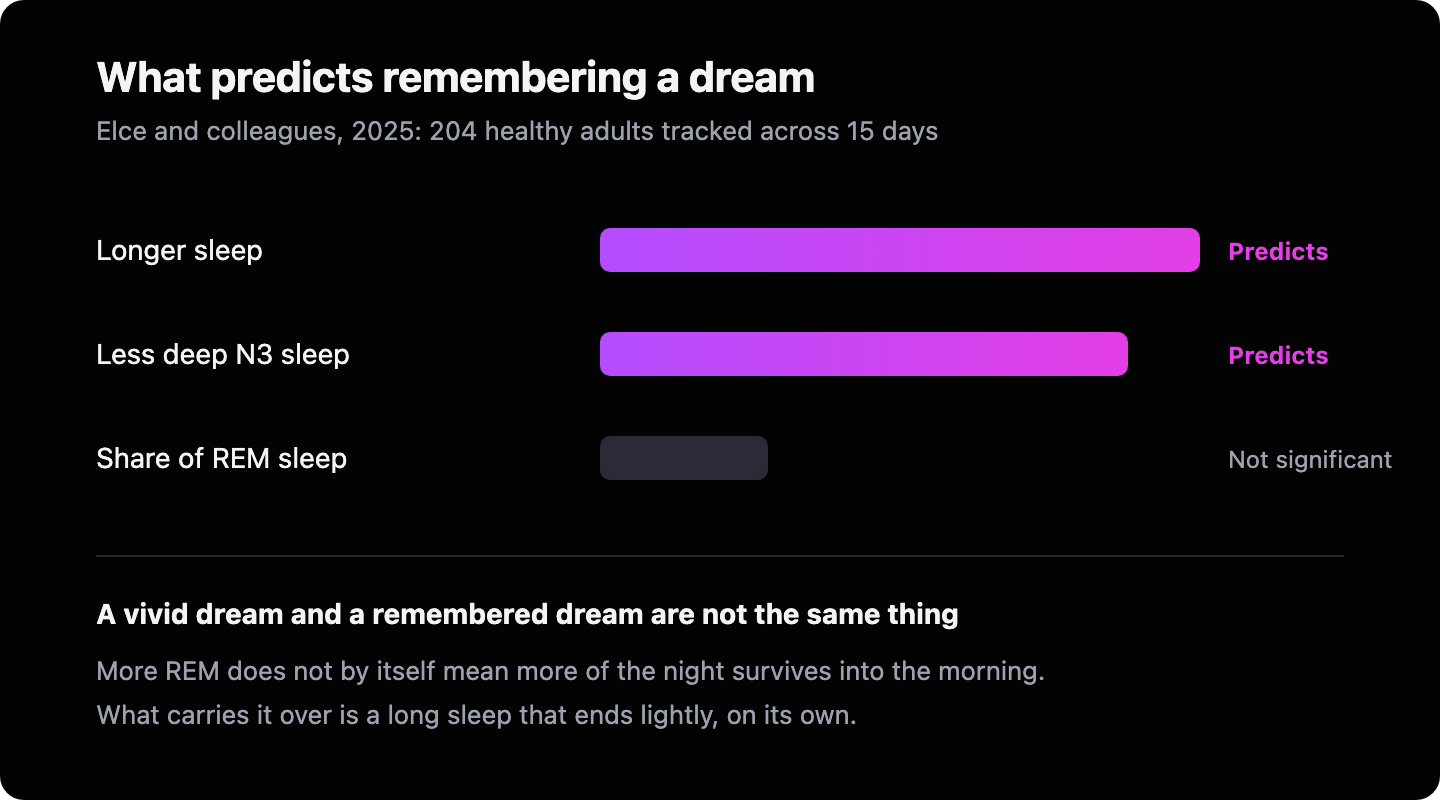
A vivid dream and a remembered dream are not the same thing.
A free morning simply creates several conditions at once under which the memory has an easier time surviving until you open your eyes, more sleep, less deep sleep toward the end of the night, and a waking that happens on its own more often.
So it can seem that Saturday dreams have become extraordinarily vivid, when part of the effect actually happens after sleep, in the first minutes of being awake.
The story is still there in full, then you start thinking about what needs doing, pick up the phone, get out of bed, and the scenes begin to disappear one after another.
Writing a dream down straight after waking therefore beats trying to reconstruct it later from memory. The dream journal Alisie has a morning reminder for this, and you pick the time yourself, set to the hour you actually get up. It lands in those first minutes, while the story still holds together.
So can you just catch up on sleep at the weekend?
Extra sleep does restore part of what the working week took, but different functions recover at very different speeds.
In Van Dongen and Dinges's 2003 study, chronic restriction to five or six hours a night led to a pronounced neurobehavioural deficit. Recovery nights improved the state, but the return of the subjective sense of "I'm rested now" ran ahead of full recovery on the objective measures.
Two extra Saturday hours can give back some of the sleep, then, without turning a week of chronic deprivation into a week of decent nights.
Chronobiologist Till Roenneberg called the gap between weekday and weekend schedules social jetlag in 2006. If you're up at seven five days running and sleep until eleven on Saturday, your body isn't getting extra sleep so much as an entirely different timetable.
For dreams that shift is one of the reasons weekday and weekend nights keep feeling different, year after year.
On weekdays you cut the morning short before REM has room to unfold, and on a free day the alarm finally stays quiet, leaving you inside that part of the night.
A long Saturday dream, then, is not a separate kind of dreaming.
It is the morning you spent all week not letting yourself watch to the end.