 Alisie
How Sleep Rebuilds Memory While You Dream
Sleep does not file the day's memories away for safekeeping. It takes them apart and rebuilds them, strengthening some, discarding most, and folding what survives into what you already knew. That rebuilding is called consolidation, and the evidence for it is genuinely strong. Across studies, people who sleep after learning retain moderately more than people who stay awake for the same hours, with a recent replication putting the effect at d = 0.47-0.77. What is far less settled is the tidy story most people have heard about how it works. Below is what actually holds up, what quietly failed to replicate, and the one part of this process you can observe in yourself, because your dreams are made of the same material your brain spent the night working on.
Sleep Rebuilds Memories, It Doesn't Store Them
The dominant framework linking sleep and memory is active systems consolidation, developed largely by Jan Born and colleagues. It makes three claims, and the third is the one that matters most.
Memories formed during the day are reactivated during sleep. That reactivation is selective: the brain does not process everything, and most of the day is simply let go. And crucially, memories change qualitatively in the process, and what gets consolidated is the gist, the pattern, the thing that generalizes, not a faithful recording. This is the part people get wrong, namely consolidation is not a save operation but something closer to an edit, and the output is not identical to the input.
The proposed mechanism is a transfer, the hippocampus, which captures experience quickly but temporarily, replays its content to the neocortex, where memory is stored durably and integrated with everything else you know. The evidence here needs stating precisely, because popular accounts routinely overstate it. What is genuinely established is that neurons reactivate task-related patterns during sleep, and that the relevant brain rhythms exist and are precisely coordinated. What has never actually been observed is a memory moving from one structure to another. Systems consolidation is a well-supported model, not a photographed event, and a 2025 review describes current models as incomplete and in places conflicting, hippocampal involvement in recalling very old memories sits awkwardly with a clean hand-off.
There is also a serious rival, and it may be complementary rather than opposed, Giulio Tononi and Chiara Cirelli's synaptic homeostasis hypothesis, in which sleep scales synaptic strength down across the board, improving the signal-to-noise ratio of what remains. On that account, sleep helps memory partly by forgetting efficiently.
The Three Rhythms That Do the Work
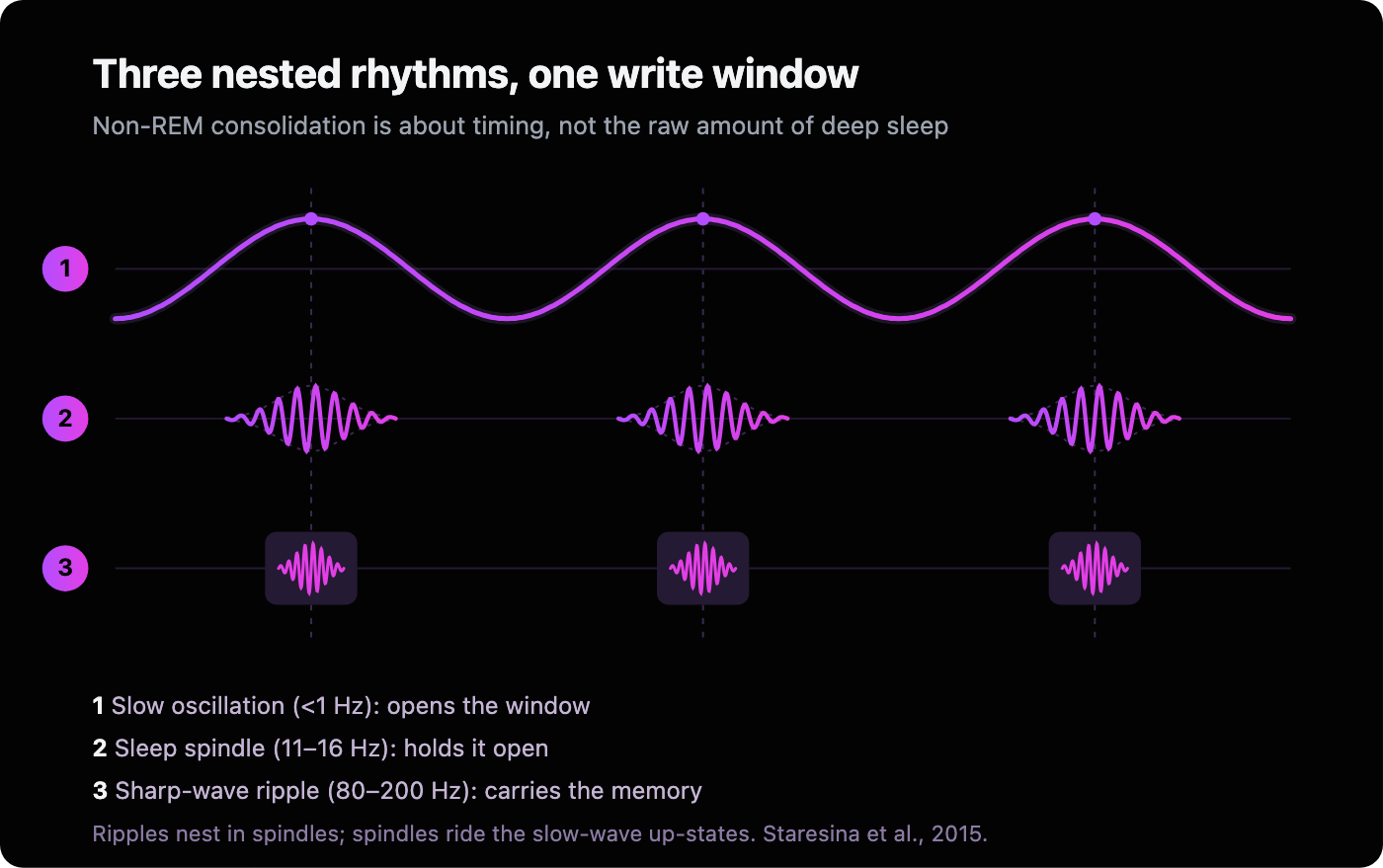
Consolidation appears to depend less on how many minutes of deep sleep you get than on how precisely three brain rhythms line up.
During non-REM sleep, slow oscillations (under 1 Hz) sweep across the cortex, setting a rhythm. Nested inside them come sleep spindles (11-16 Hz), brief bursts of activity from the thalamus. And nested inside those come sharp-wave ripples (roughly 80-200 Hz, depending on species and definition), fast bursts from the hippocampus that carry the reactivated content. Human intracranial recordings confirmed this hierarchy directly. Bernhard Staresina and colleagues showed in 2015 that ripples cluster in the troughs of spindles, which in turn ride on the slow oscillation.
The useful way to think about it is timing, not quantity. The slow oscillation opens a window; the spindle holds it open; the ripple delivers the content. Consolidation looks like a scheduled write, and what matters is that the three arrive in the right order.
The replay itself was first seen in rats. In 1994, Matthew Wilson and Bruce McNaughton reported that hippocampal cells active while an animal ran a maze fired together again during subsequent sleep, though it is worth noting they showed correlated co-firing, not ordered sequence replay. The ordered version came in 2002, when Lee and Wilson demonstrated that the sequence was replayed in compressed bursts of about 100 milliseconds, roughly twenty times faster than the rat had actually run it. In humans, direct evidence of replay remains thin, because observing it requires electrodes inside the brain. Most human evidence is inferred rather than seen.
Where the Textbook Story Goes Wrong
You have probably encountered the neat version: deep sleep handles facts, REM sleep handles skills and emotions. It is in a lot of textbooks. It does not hold up as a clean split, and repeating it in 2026 is repeating a simplification from the 1990s.
The dichotomy never quite fit the data. Visual texture discrimination, a non-declarative, perceptual skill that the model assigns to REM, is supported by slow-wave sleep. The declarative/procedural boundary itself is dissolving. Motor memories, long assumed to bypass the hippocampus, turn out to involve it. And the REM half of the story was always the weaker half. Born himself, whose framework this is, described REM's function as "presently obscure", not the kind of thing you say about a stage whose job you have pinned down.
The current framing is different and more interesting. Rather than different memory types being handled in different stages, non-REM appears to stabilize memories while REM integrates and abstracts them, different operations performed on the same material. Which is a better description of what sleep does to a memory anyway, namely it doesn't sort your day into two folders, it works the day over.
Several other familiar claims are shakier than their popularity suggests, and they are worth naming because you will meet all of them:
"Sleep protects memories from interference" failed to replicate. The original finding is a staple of popular sleep writing; a larger attempt (97 participants versus roughly 40) found sleep and wake groups forgot at statistically identical rates.
"Spindle density predicts intelligence" is probably a false positive. A meta-analysis of around 22 studies found essentially no evidence for density, the very parameter usually cited. Only spindle amplitude survives, and weakly.
"Sleep deprivation cuts your ability to learn by 40%" is a number I would not print. It does not appear in the abstract of the study it is usually attributed to, it describes 35 hours of total deprivation rather than a bad night, and it is a relative figure pooled across stimulus types. The underlying direction is real; the number is folklore. Better evidence comes from meta-analysis, which finds a moderate effect of pre-learning deprivation (g = 0.62) and a smaller one for deprivation after learning (g = 0.28).
That last pair is worth pausing on, because it inverts the usual advice: a sleepless night damages tomorrow's learning more than yesterday's. Sleep matters before encoding, not only after it.
What the Night Actually Does to Your Day
Set aside the claims that failed to replicate, and what remains says something specific about the night you just had.
The night is not a pause between two days. It is where the day gets processed. Gais, Lucas and Born demonstrated this cleanly in 2006 by teaching people vocabulary in the morning and in the evening, so that time of day could not explain the result. Sleep after the experience beat staying awake, whichever way round they ran it. And the night keeps working after the first one: on a finger-tapping task, people improved about 17% in speed after a single night, and 26% after three, with no comparable gain across twelve waking hours. Whatever your brain is doing with a day, it isn't finished by morning.
A sleepless night damages tomorrow more than yesterday. This is the asymmetry most people have backwards. Missing sleep after an experience does blunt how well it settles (g = 0.28 in meta-analysis), but missing sleep before one is markedly worse (g = 0.62): the brain that hasn't slept is bad at taking anything in at all. The night is not only where yesterday gets filed; it is what makes you capable of having tomorrow.
Chronic six-hour nights are worse than they feel. Van Dongen and colleagues held people at four, six or eight hours in bed for two weeks. Deficits from six hours accumulated steadily across all fourteen nights, and here is the disturbing part: participants' subjective sleepiness levelled off while their objective performance kept falling. People running on six hours do not feel as impaired as they measurably are, which is precisely why the damage goes unnoticed.
Which hours you lose matters, not just how many. Deep sleep is concentrated in the first half of the night, REM in the second. A late bedtime with a fixed alarm costs you slow-wave sleep. An early alarm with a fixed bedtime costs you the REM-rich morning hours, and those are the same hours when most of the dreams you could actually remember are happening. Cut the end of your night and you are not just losing sleep; you are cutting off the part of it you would have been able to see. That asymmetry is a property of how the sleep cycle is built.
And one thing the night will not do for you: you cannot learn new material by playing audio while you sleep. Simon and Emmons settled that in 1956, showing on EEG that apparent "sleep learning" only happened when the recording woke people up. But the myth has an interesting shadow. Targeted memory reactivation, attaching a smell or a sound to something you learned while awake and then replaying that cue during deep sleep, genuinely does strengthen it. A meta-analysis of 91 experiments (about 2,000 participants) found a small but real effect, present in non-REM sleep and absent in REM. The sleeping brain can work on what you gave it. It cannot be handed something new. (The exception people reasonably ask about is lucid dreaming, where you are conscious and acting inside the dream rather than being played a recording. Rehearsing a movement in a lucid dream does appear to improve it in waking life. That is a different phenomenon, and it depends on the very thing the audio myth lacks, a mind that is awake enough to practise.)
What This Has to Do With Your Dreams
Your dreams are made of the material sleep is working on, but they are not a recording of it. If sleep is reworking your memories, and dreams occur during sleep, the obvious guess is that dreams are that rework, that you are watching the tape get replayed. That guess is wrong in a specific and useful way, namely the material is unmistakably yours, and the arrangement is never a copy.
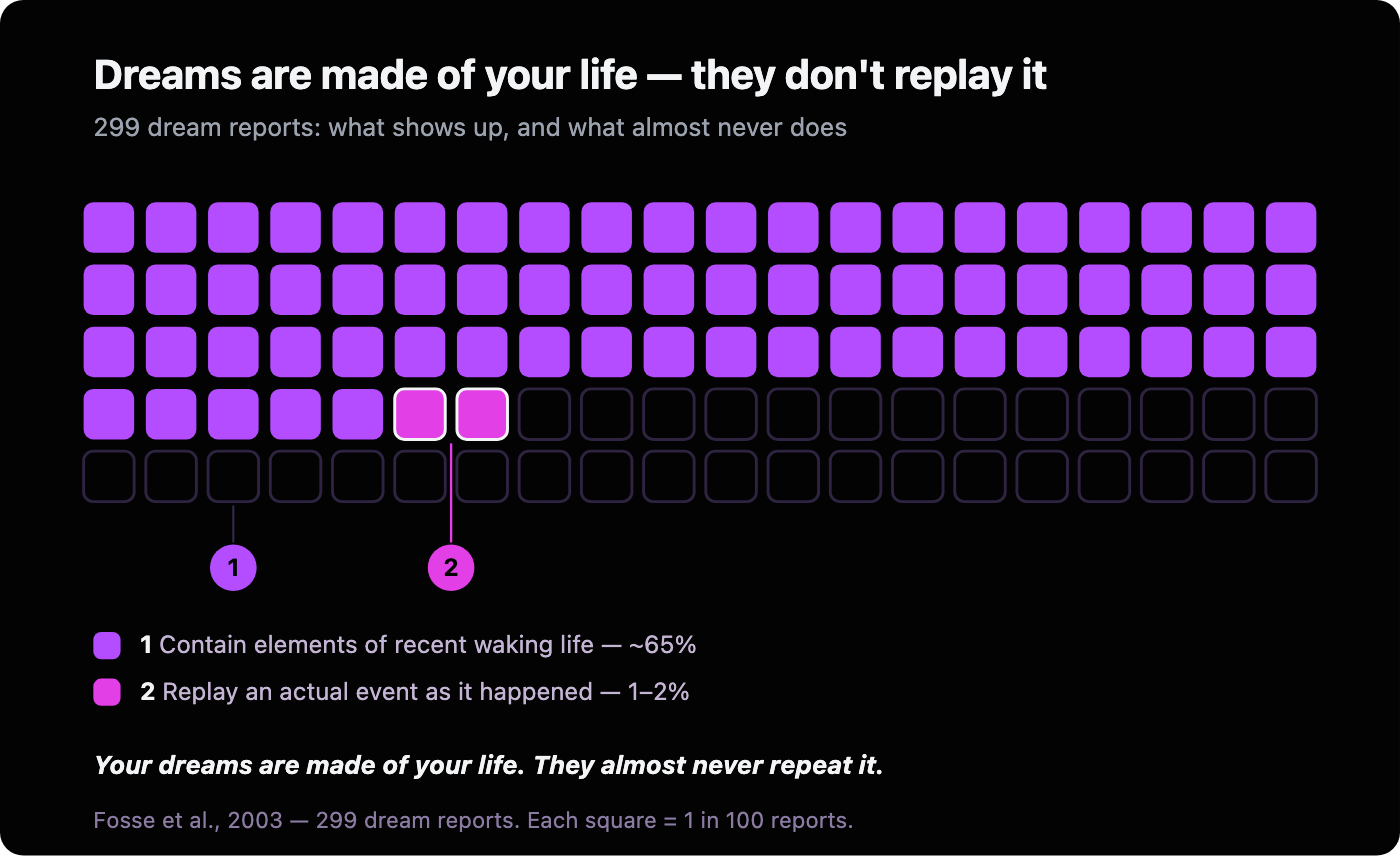
In 2003, Fosse, Fosse, Hobson and Stickgold examined 299 sleep-mentation reports. About 65% contained something traceable to recent waking life, so the continuity is real. But episodic replay, an actual event from your life re-running as it happened, appeared in no more than 1-2% of reports. Dreams are made of your life, and they almost never repeat it.
What they do instead is recombine. The most vivid demonstration is Robert Stickgold's Tetris study, published in Science in 2000. Participants played seven hours of Tetris over three days, and 63% of them, 17 of 27, reported hypnagogic images of falling blocks as they drifted off. Not one of them reported playing the game. There were no desks, no keyboards, no scoreboards, no sense of sitting in a lab. The imagery was abstracted down to shapes that needed fitting together. As the authors noted, none of the reports described episodic memories at all, and why that happens is the whole story of the Tetris effect.
Two details from that study matter more than the headline.
The first detail is the patients, five participants had amnesia from bilateral damage to the medial temporal lobes, including the hippocampus. They could not remember playing Tetris. They could not remember the experimenter from one day to the next. One of them, having showered and put on pajamas, found the researcher sitting in her bedroom and asked who he was and what he was doing there. And yet three of those five produced Tetris imagery at sleep onset, at a rate statistically indistinguishable from healthy participants. One said: "images that are turned on their side. I don't know what they are from, I wish I could remember, but they are like blocks." The experience surfaced without the memory of where it came from.
The second detail is the timing. The imagery peaked in the first seconds of sleep, and 90% of the novices' reports came on the second night, not the first, a day's delay, which is not what a simple, automatic replay of the last thing you did would produce.
The same pattern shows up when the task is harder. In 2010, Erin Wamsley and colleagues had 99 people learn a 3D virtual maze, then nap. Four of them mentioned the maze in their dream reports, and those four improved roughly tenfold more than the sleepers who didn't. But look at what they actually dreamed, two heard the music from the task, one thought about the upcoming retest, and three found themselves in other maze-like places, one lost in a bat cave. Nobody re-ran the maze itself; what came back was the shape of the problem, not the problem.
The delay is the part that slips memory entirely. You learn something on Monday and dream a sideways version of it on Wednesday, with nothing to tie the two together in the moment. in Alisie every entry has an Analysis field where you can note what a given day held right beside the dream, so a lag you could never feel from inside one night becomes something you can lay end to end and actually see.
This study is routinely oversold, and two things rein it back in. That tenfold figure rests on four people, and those four were significantly worse at baseline than everyone else, so they had the most room to improve. The effect replicated in a full-night study in 2019, and a 2023 meta-analysis of 16 studies found the dreaming-memory association holds at a moderate size (SMD = 0.51), significant in non-REM dreams and, notably, not significant in REM. So the association is real. But the authors are unusually blunt about what it isn't. In their own words:
"It is not our contention that dream experiences cause memory consolidation during sleep."
Their claim is that dreaming and the memory benefit both flow from the same underlying process, reactivation. Dreaming isn't doing the consolidating; it is what that process looks like from the inside. Wamsley's own metaphor is a good one, dreams are the tip of a mental iceberg, the visible sign of a great deal of invisible work.
Not everyone even grants that much. G. William Domhoff, whose neurocognitive theory treats dreaming as a byproduct of the mind's capacity to imagine, points out that patients who lose dreaming entirely after brain injury go on sleeping normally and functioning fine, and that young children, the best learners alive, dream least of all. The honest position is that dreaming may index consolidation without contributing to it. Nobody has ever manipulated dreaming experimentally, so nobody can currently say otherwise. Memory consolidation is, in fact, only one of the four live hypotheses about why we dream at all, and the psychology of dreams sets it beside the other three.
Reading the Rebuild: Why This Needs a Journal
The dream-memory findings all have the same shape. The effect showed up in four participants out of fifty, appeared on the second night rather than the first, and surfaced as a bat cave rather than a maze, as blocks rather than a game, as background music rather than a lesson. It was strongest in the people who had struggled most, and the association only became visible at all once someone pooled sixteen studies.
None of that is observable in a single dream. It is a statistical shape, and it only appears across a series, which is exactly how the science itself works. Content analysis has never been about interpreting one dream; it is about counting what recurs across dozens.
That is the thing a dream journal can actually give you, and it is worth being precise about what it can't. There is no evidence that keeping a dream journal improves your waking memory. Nobody has tested it, and we are not going to imply it. Consolidation happens whether or not you remember a single dream. What journaling reliably improves is dream recall itself, and that much is well established, along with the handful of habits that improve it, starting with catching the dream in the first minute before it fades. What better recall makes possible is observation. Reassuringly, the one study to check found that waking to record dreams doesn't damage consolidation either.
But if you learn something hard this week, a language, a piece of music, a new codebase, a route through an unfamiliar city, the evidence says it will show up in your dreams, reshaped, probably a day or two late, almost certainly not as itself. And you will most likely never notice, because a single strange dream about a cave tells you nothing about the pattern, while forty nights of them tell you quite a lot.
That is where a record earns its place. Mark the characters, creatures, locations, artifacts and whatever else stood out in an entry, and a count builds across your whole archive, so what recurs stops being a vague impression and becomes a number you can point to.
The maze dreamers weren't dreaming of corridors; they were dreaming of caves and checkpoints, which is an associative structure rather than a copy. A connections graph maps exactly that, which elements of your dreams keep turning up together, the way the science reads a series rather than a single night.
Over months, that archive becomes an encyclopedia of your own dreams, the only place the pattern in your own consolidation is ever going to be legible.
The Short Version
Sleep consolidates memory by reactivating your day selectively and rebuilding it into something more general than the events themselves, a process carried by the precise nesting of slow oscillations, spindles and ripples during non-REM sleep. The effect is real and moderate, but the tidy textbook split of "deep sleep for facts, REM for skills" is a 1990s simplification, and several famous claims around it have quietly failed to replicate. The night is not a pause between two days, and it takes yesterday apart and makes you fit for tomorrow, and it is tomorrow that suffers most when you cut the night short.
And the strangest finding is the one closest to home. What you learn does reappear in your dreams, pulled apart and recombined, a day or two late, and the association between dreaming about something and remembering it better is real, if not causal. You cannot see it in one night. You can see it in a hundred, which is the entire reason to write them down.