 Alisie
Why Meditators Have More Lucid Dreams
People who meditate every day report noticeably more lucid dreams than people who don't. It's one of the more reliable correlations in a field full of shaky ones, and the reason it's plausible is easy to feel, because a lucid dream is a moment of noticing your own mind from the inside, which is more or less what meditation trains you to do while awake. But before you take up a cushion expecting your nights to change, there's a catch worth knowing: the link has a point where it stops.
The honest version is narrower and more interesting than the headline. The link is real, but it belongs to people who have meditated for a long time, and when researchers tried to create it on purpose, with a course, it didn't appear. What that leaves you with isn't a technique to trust on faith. It's a question that only your own practice, tracked night by night, can settle.
Daily meditators really do report more lucid dreams
The link itself is the strongest thing here. People who meditate daily report noticeably more lucid dreams a month than everyone else, and long-term meditators show the same picture. Across different groups of people, the people with a serious meditation habit are dreaming lucidly more often.
Two details matter for reading this correctly. The effect tracked daily practice, and meditating once a week showed no significant advantage, so whatever is going on, it seems to want a real habit rather than an occasional sit. And the one style that stood out was open monitoring, the kind of practice where you watch whatever arises in the mind without fixing on a single object, rather than tightly focused attention. It's a modest signal, from self-reports rather than sleep-lab counts, so hold it loosely. But it points the same way every time, steady practice, more lucidity.
But eight weeks of practice won't buy it
Here is where the catch surfaces. When researchers ran the obvious experiment, taking people who don't meditate, putting them through an eight-week mindfulness course, and seeing if their lucid dreams go up, nothing happened. The course produced no increase.
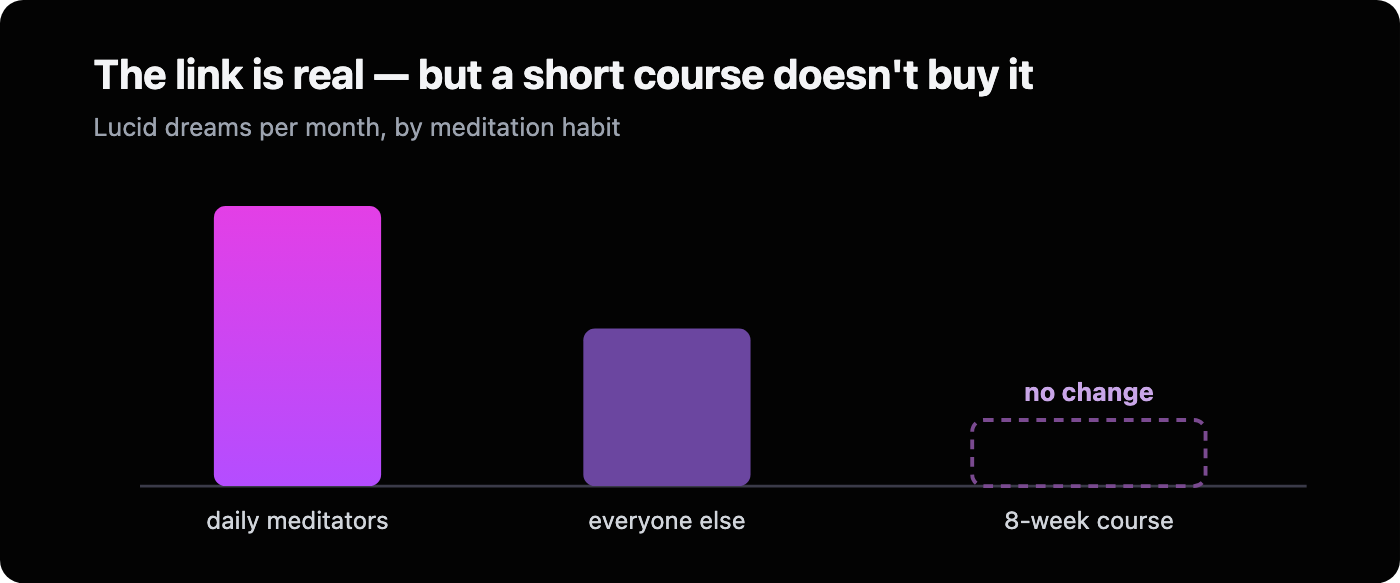
That is not a small footnote. It's the difference between a correlation and a promise. The people who dream lucidly more often are the ones with years behind them, not the ones who started a program last month. So the advice you'll see everywhere, "meditate for a while and you'll start having lucid dreams", runs ahead of what anyone has actually shown. Whatever the long-term meditators have, two months doesn't hand it over.
None of which means the practice is pointless for your dreams. It means the relationship is slower and less certain than the slogans suggest, closer to a long, quiet drift than a switch you flip. And a slow, uncertain effect in a group average is exactly the kind of thing that stays invisible to you until you have your own nights to look at, which means first remembering them well enough to write down.
Why the link is there at all - a guess about metacognition
The most plausible explanation is a shared skill called metacognition, the mind watching itself. Noticing, while awake, that you're lost in thought is the same basic move as noticing, while asleep, that you're dreaming. Meditation is sustained training in the first; a lucid dream is the second arriving on its own. If they draw on the same underlying capacity, the correlation makes sense.
The brain evidence is suggestive but unsettled, and it's worth being straight about that. One study found that people with more frequent lucid dreams had more grey matter in the frontal pole, a region tied to monitoring your own thoughts, and that the same area lit up during a waking thought-monitoring task, which is promising. But a later study didn't reproduce the structural difference. It found only differences in how the regions were connected, not in their size. So treat metacognition as the leading guess for why meditation and lucidity travel together, not as an established mechanism, an elegant idea whose wiring is still being argued over.
The arrow may point both ways
There's a tidy story people tell, namely that meditators are simply the kind of self-aware people who were always going to dream lucidly, and one study quietly takes it apart. They ran people through a twelve-week lucid-dream training program and measured them before and after. At the start, the ones who went on to succeed were no different from the ones who didn't, on any of the traits you'd expect to matter. But by the end, the successful group had shifted, measurably more field-independent than when they began.
And it flips the usual assumption. It wasn't a pre-existing personality that produced the lucid dreams, it was the experience of lucid dreaming that changed the person. Which means the arrow between an inner practice and a lucid life may run in both directions at once, and untangling which way it runs in you is not something a group study can do. It needs your own before and after.
Which is really an argument for writing your nights down and keeping them. A record in Alisie holds the stretch of nights before you took up a practice and the stretch after, side by side and searchable, so a shift you could never feel from inside a single morning is there to be read once enough of them have piled up. The before-and-after that a group study runs across strangers, you run across your own months.

No lucidity technique is guaranteed - meditation included
The most thorough review of lucid-dream induction studies reached a blunt conclusion. No technique has been shown to reliably and consistently produce lucid dreams. The same review noted that lucidity tends to fade if you stop practising. This is a skill with real but limited evidence behind it, not a set of levers that work on demand, and meditation sits in exactly the same row as every other approach.
The idea itself is old, for what it's worth. Aristotle noticed awareness within dreams, and Tibetan dream yoga built centuries of practice around holding consciousness through sleep. That history is context, not proof; a tradition being ancient says nothing about whether it works. What the modern evidence actually supports is humbler and more honest, namely some approaches raise your odds above chance, meditation among them, and none of them promise a result. Which is precisely why the loud promise of a "reliable method" is one to distrust, and why the only reliable thing is a record of what happened when you tried.
How to find out whether it works for your dreams
Everything above is about averages, groups of meditators, measured against groups who don't. What none of it can tell you is whether your practice does anything for your lucid dreams. That answer isn't in any dataset. It's in the series of nights only you can keep.
To get it, put meditation in the same row as the other lucidity techniques, reality checks and an intention set before sleep, and watch it the way you'd watch any of them. From there it stays simple enough, so note which one you leaned on, mark the nights that turned lucid, and keep it up long enough that the tally, not a hunch, tells you whether meditation is doing anything for you.
The group averages say the link exists across people in general. Whether it exists for you is the open question. For some, meditation really does move the nights; for others it doesn't, and no average reaches down far enough to tell you which one you are.