 Alisie
What the MILD Technique Is and How to Do It
MILD is a technique for becoming lucid, for realising in the middle of a dream that you are dreaming. The name stands for mnemonic induction of lucid dreams. You wake in the night, recall the dream you have just had, and pick out something in it that could not have happened while awake. You then replay that moment in your head as though you catch it and realise you are asleep. And you drift off repeating a single line: next time I'm dreaming, I will remember I'm dreaming.
The intention is aimed at memory
"I want a lucid dream" and "I will remember I'm dreaming" look like the same wish in different words, until you ask what each one actually asks of you. The first stays a vague hope. The second is a job to be done at a specific moment, the kind people set themselves all the time while awake, like leaving the house and taking the keys, and manage to recall when the moment arrives. MILD leans on that ordinary ability.
Stephen LaBerge, who developed the technique, reported this back in 1980. Over three years of tracking his own sleep, autosuggestion produced between 1 and 13 lucid dreams a month, averaging 5.4; MILD produced between 18 and 26, averaging 21.5. One person, self-recorded, so it reads as the technique's origin story rather than proof of anything. Still, the wish was present either way. What changed was how the task was phrased.
The wording itself is yours to choose. LaBerge treated the exact sentence as secondary to having a specific intention at all.
Where the practice starts
You start with the dream, reconstructing it in as much detail as you can, down to the place, the people, what happened, what you thought and felt at the time. Then you look for the oddity, something that could not occur in waking life. A dead relative chatting away as if nothing were unusual. A place that does not exist. Something that breaks physics outright. These are called dream signs. Awake, any of them would stop you short; asleep, you take them as an ordinary part of what is going on, and that gap is what the technique works on.
Having found one, you go back into the dream in your mind and replay the scene as though you notice it this time and understand you are asleep. You live through the moment of recognition in familiar surroundings, feel what it is like, and run the scene a few times over.
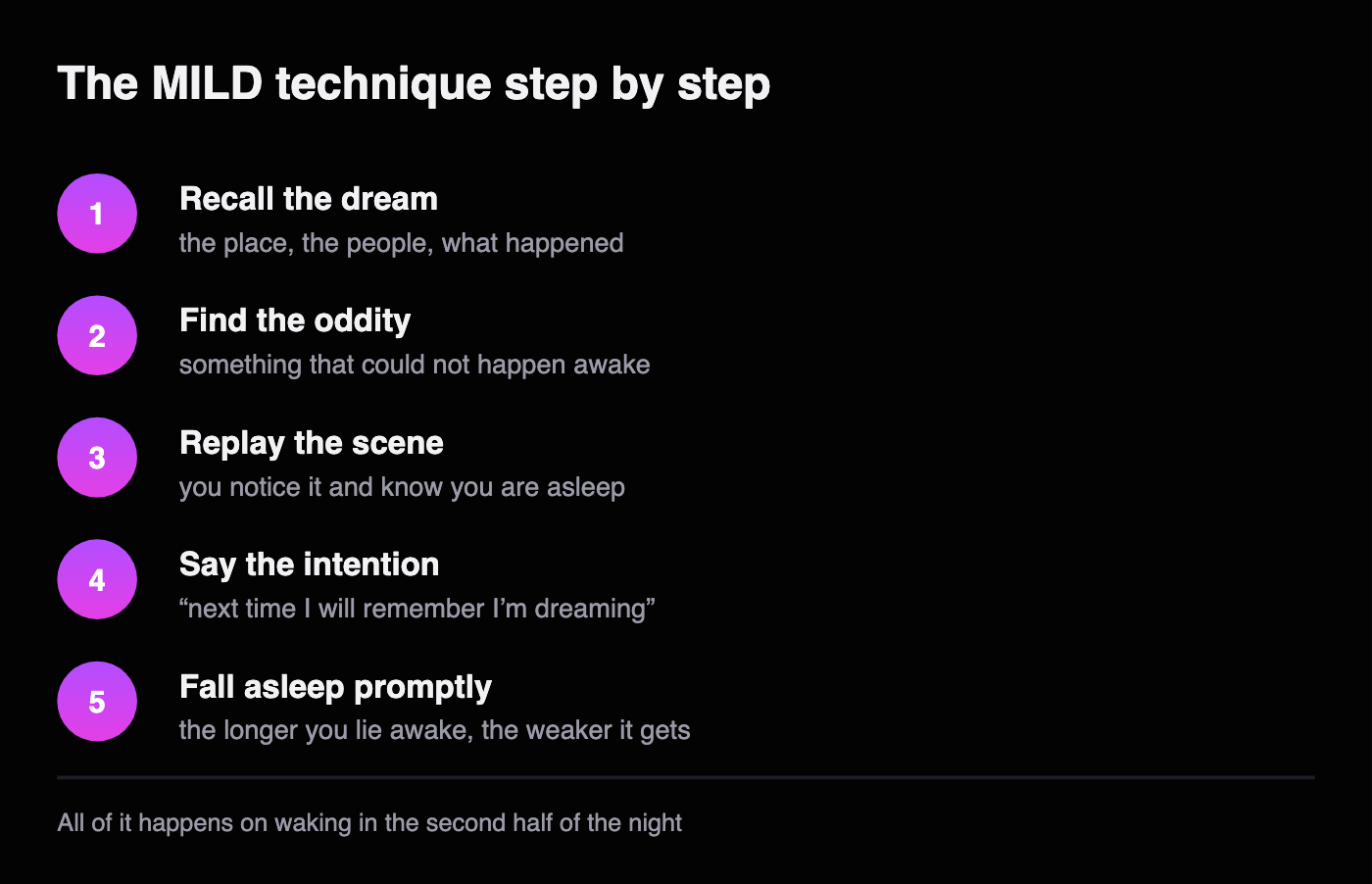
LaBerge's own account includes one more element that popular versions tend to drop. Along with the recognition, you picture a specific thing you intend to do once you know you are dreaming. Other groups leave this out of their procedure descriptions, so it is not something to treat as mandatory, though the technique's author included it.
The dream sign stays rehearsal material and nothing more. The next dream may hand you something similar or something entirely different, and the point is to remember you are asleep either way.
Finding an oddity worth rehearsing
The useful dream signs are the ones from your own nights, particularly whatever keeps coming back. Everyone's set is different: a school you left decades ago, being perpetually late, impossible places, conversations with people long dead. Rehearsing something you are likely to meet again is the whole idea.
Memory is bad at spotting these patterns, and it all rests on how well you recall your dreams in the first place. That school feels like it turned up once or twice, and then six months of entries put it far higher than that. In the dream journal Alisie you mark characters, places and creatures as you write, the app totals them across your archive, and a Popular screen puts the most frequent ones in front of you. Reading that list and deciding what counts as an oddity is still your call.
How long to hold the intention
You hold the intention, letting stray thoughts go, until it feels clear. LaBerge described it as cycling through the phrase and the mental replay until the intention settles or sleep takes over.
In 2018 he and his colleagues tested this with 121 participants. MILD was part of a combined protocol there, and practising for at least ten minutes was associated with a higher chance of a lucid dream, while the total number of minutes spent on the technique predicted nothing on its own. The 2020 international lucid dream induction study, with 355 participants, looked at how many times people repeated the phrase and found no link to success in any group.
So there is no case for turning MILD into a repetition count. Ten minutes is a rough guide, not a threshold that clicks over into something.
The hour awake matters more than the waking
MILD is done on waking in the second half of the night, five or six hours in. REM periods run longer towards morning, which puts the technique nearer the stretch of night where most dreaming happens.
Erlacher and Stumbrys measured how long that gap should be in 2020, in a sleep lab with recordings, in groups of eleven to fifteen. Participants slept six hours, woke, spent some time working with their dreams and doing MILD. An hour awake produced lucid dreams in 53-54% of participants; half an hour, in 36%. Control conditions spent the same hour awake doing something else, and reading came out at 9%, playing a console game at none at all.
Simply being awake, then, does little by itself. The advantage went to conditions where the hour was spent on dream work and MILD rather than reading or gaming. In that experiment the console hour produced no lucid dreams at all.
Those first minutes are worth spending in a way that keeps you from dropping straight off. Sitting up a little helps, since lying down it is easy to fall asleep mid-practice, before you get to the intention.
Falling asleep fast beats finding the perfect words
Having the intention is one thing; carrying it into the next dream is another. Denholm Aspy's 2017 study had 169 participants. Fourteen of them had occasions where they managed to fall asleep in under five minutes after MILD, and on those occasions lucid dreams were recorded on 45.8% of nights, against 24.6% across their other attempts. The 2020 international study did not confirm the five-minute mark but did find a significant difference at ten minutes. The exact threshold differs between the two, though both point the same way. After MILD, it is better to get back to sleep reasonably fast.
Gott and colleagues offer a partial explanation from the same year, in which lucidity was associated with fast transitions from waking into REM, while subjective sleep quality and the number of awakenings showed no such link. Possibly the sooner you are back asleep, the closer your intention sits to the next REM period.
Which is why chasing the ideal phrasing is beside the point. What matters is running the sequence, forming the intention, picturing the moment of recognition, then letting yourself fall asleep.
In that same international study, participants spent one week simply keeping records and a second week practising, and the share of nights with lucid dreams rose from 5.3% to 15.8%. Roughly one night in six instead of one in twenty, which is why a run of nights tells you more than a single attempt that went nowhere.