 Alisie
How Dreams Change as You Age
"I used to dream more" is a common enough feeling, and age usually gets the blame. The logic seems sound enough, in that sleep gets worse and so dreams get scarcer.
Testing that feeling is harder than it sounds. Asking someone how often they dream is not the same as finding out how often they do.
Dreams Don't Stop - They Get Harder to Catch
People really do report fewer dreams as they get older. Surveys show recall dropping off, which makes it easy to conclude the dreams themselves are fading. Lab work points elsewhere, because when you wake someone during REM sleep and the gap between young and old shrinks considerably.
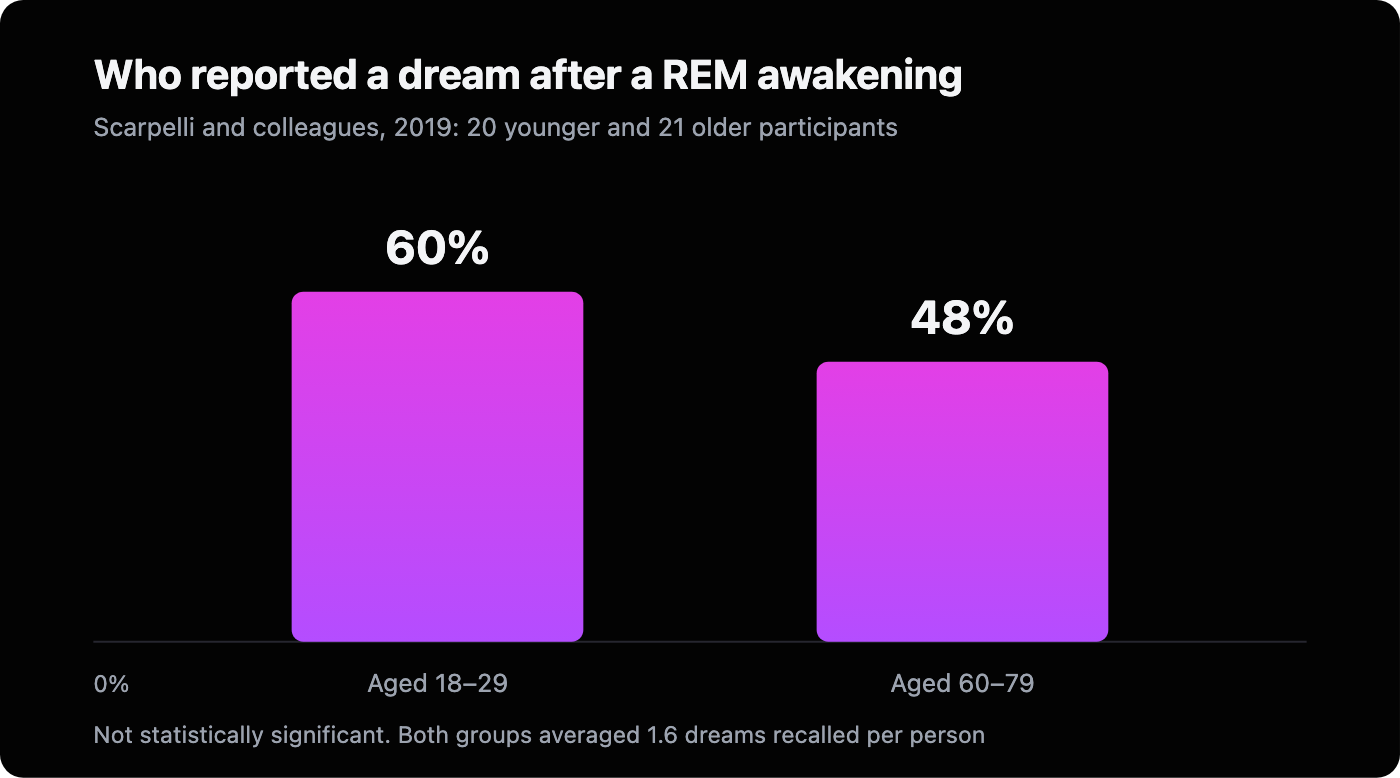
Scarpelli and colleagues tested this in 2019 with 21 adults aged 60 to 79 and 20 younger ones aged 18 to 29. Woken out of REM, 10 of the older group reported a dream against 12 of the younger, roughly 48% versus 60%, a difference that did not reach statistical significance. Both groups averaged the same number of dreams recalled: 1.6 per person.
The brain signal matched too. In both age groups a dream was more likely to be reported when the final stretch of REM before waking carried strong frontal theta activity, around 6.5 Hz.
Home diaries say much the same. Waterman found in 1991 that adults aged 45-60 and 61-75 differed neither in how often they recalled dreams nor in how long their accounts ran.
Your own journal measures the same thing. The search in Alisie pulls up entries from years back, and set beside this morning's they either run shorter or they don't.
The idea of a steep decline traces to one study. In 1969 a lab found adults aged 66 to 87 reporting dreams after REM awakenings 45% of the time, against 87% for 18-to-33-year-olds in an earlier study. The samples were small, and the two figures come from separate studies run years apart.
Nielsen's 2012 internet survey found the same downward trend across 28,888 respondents aged 10 to 79, though they were volunteers who found their way to a website about dreams, not a representative sample.
Waking up with nothing to report happens more often with age, and the sense that dreams have thinned out follows from that. Dream recall itself stays trainable at any age.
The Night Fragments, but REM Holds
The night does change with age, though the shifts in REM are far too small to account for the drop in recall.
Wakefulness moves most, and between ages 30 and 60, time spent awake in the middle of the night climbs by roughly 10 minutes per decade, then stops climbing after 60. Total sleep contracts by about 8 minutes per decade in men and 10 in women, and that shrinkage levels off after 60 as well.
REM declines far more slowly, around 0.6% per decade between ages 19 and 75, with a slight rebound between 75 and 85. Deep sleep drops by about 1.7% per decade in men, while the same data show no change in women. The body clock shifts about an hour earlier. These figures come from Ohayon and colleagues' 2004 meta-analysis, pooling 65 studies and 3,577 healthy people aged 5 to 102.
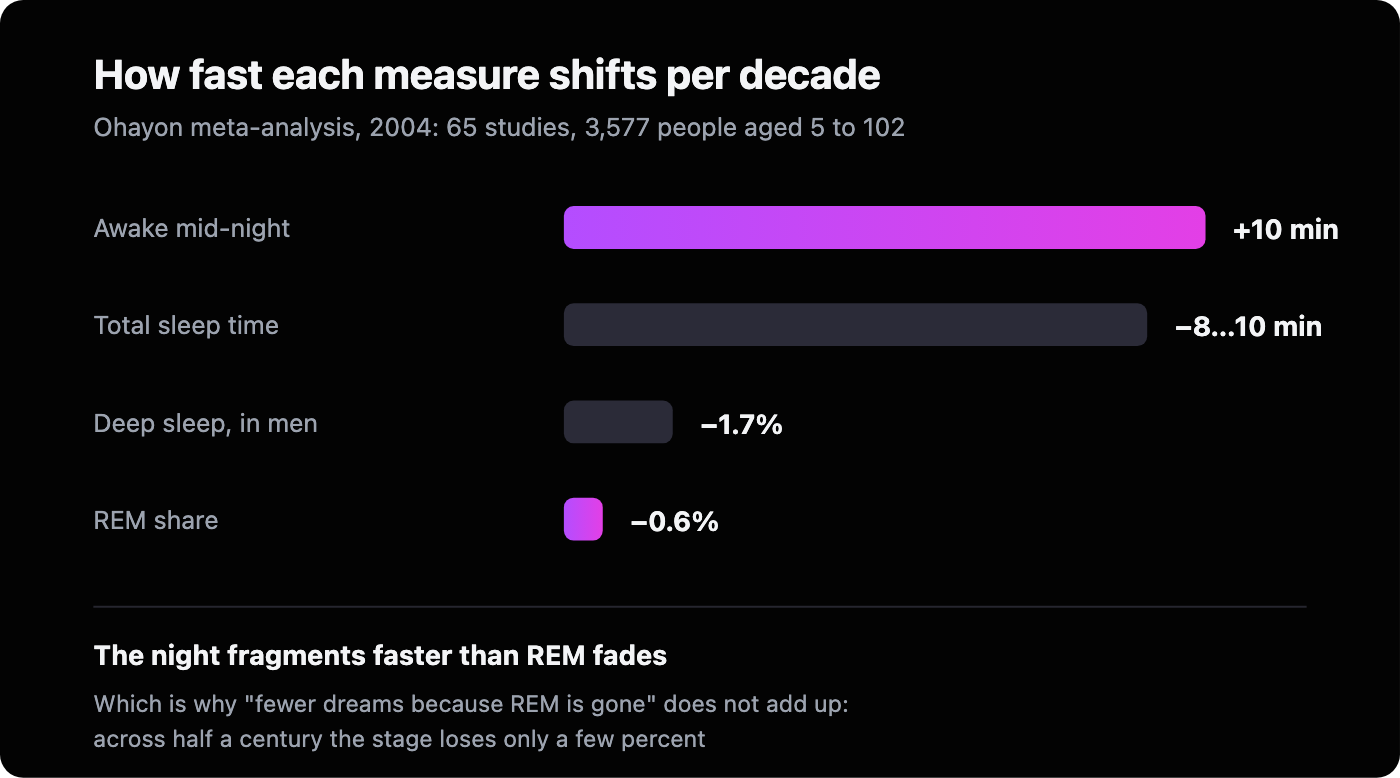
The night gets choppier and shorter. REM survives it. One fading stage cannot explain why older adults recall fewer dreams.
Dreaming Switches On Late in Childhood
A newborn sleeps around 16 hours a day, roughly half of it in REM. By ages 19 to 30 that is about 8 hours of sleep with REM taking up some 22%.
Plenty of REM does not amount to the kind of dream an adult can narrate over breakfast. Infants spend enormous stretches of the night in REM, and that alone says nothing about what they experience.
David Foulkes spent decades waking children in the lab and found the familiar form of dreaming arrives slowly. Children aged 3 to 5 reported a dream after only 17% of REM awakenings, averaging 14 words, usually a still image with no action and no child in it. Coherent stories with the dreamer as a participant settle in around ages 7 to 9.
The finding is contested, and reasonably so, because a three-year-old's brief report may reflect a missing skill rather than a missing dream, since narrating anything is hard when speech is still assembling. Home studies, where parents record dreams in familiar surroundings, get richer accounts from small children than the lab does.
Research on older adults runs into the same problem, namely what gets measured is the report, and the report is not the dream, only whatever survived the trip into words.
Lucidity Comes Free Only in Childhood
Lucid dreams shift with age as well, and not in the direction most people expect. Voss and colleagues surveyed schoolchildren and students aged 6 to 19 in 2012 and found lucid dreams markedly more common among the youngest, with frequency falling off from about age 16.
Their explanation involves brain maturation. Lucidity may ride on an immature prefrontal cortex and amount to a by-product of its development. That is a hypothesis rather than an established mechanism, and rivals to it exist.
What the survey does show is that the children in it reported lucid dreams more often than the older respondents did.
Plots Age Along With You
The odds of recalling a dream are not the only thing that shifts. What happens inside the dream shifts too.
Dale and colleagues scored the dreams of 375 Canadian women in 2015, 75 in each of five age brackets: 12-17, 18-24, 25-39, 40-64 and 65-85. Female characters, familiar characters, physical activity, aggression, friendliness, social interactions and negative emotions all declined in a straight line with age. The authors read this as a move from quantity to quality in social life, and as evidence of better emotional regulation.
A 2017 study of 231 Canadian men across the same brackets ran the same direction. Aggressive imagery peaked in adolescence. Teenagers and young adults met more threats in their dreams than people over 40, and young adults reported nightmares more often than older ones did. Hall and Domhoff had already found dream aggression falling after age 30 back in 1963, the same direction, from data gathered half a century apart.
Calmer is not poorer. What a dream is built from tracks the life of the dreamer, the memories, the people, the preoccupations. A teenager dreams of confrontation because a teenager lives among confrontations. Change the life and the dreams change with it.
Both Dale studies carry the same limit, namely each participant contributed a single dream, and the comparison ran across different people of different ages. Nobody followed one person from twelve to eighty-five. Some of the difference may separate generations rather than ages.
Your Own Curve Lives in the Record
None of this moves fast enough to notice. Ten minutes of wakefulness per decade, half a percent of REM, quantities that add up to something only across decades, and to nothing at all across a year.
Memory cannot settle it either. Any recollection of what nights were like twenty years ago gets assembled by today's memory and obeys its rules, the vivid surfaces, the ordinary erodes, and the past comes out looking richer almost every time. The sense that dreams used to be brighter proves nothing on its own.
Studies answer for averages, not for you. A mean drawn from 375 women aged twelve to eighty-five says nothing about how any one of them changed. A cross-sectional design cannot show a personal trajectory, because it was never built to.
So "I used to dream more" resolves into several different questions. The plots may have changed, or how they feel, or the structure of the night itself, or only how much of it is still there by the time you are properly awake. Telling those apart takes a long enough run of entries to have something to compare this morning against.
Dreams stay with a person for life. What changes is what they contain, and how easily you can reach them in the morning.