 Alisie
The Sleep Cycle and Why Dreams Arrive Before Dawn
Sleep isn't a single state you switch off into. Across a night your brain moves through four distinct stages, three of non-REM sleep (N1, N2, N3) and REM, each with its own brain activity and its own job, repeating in cycles of roughly 90 minutes, four to six times over. And the mix isn't constant; it shifts as the night goes on. Once you see that structure, a lot falls into place: why the first hours feel the deepest, why most dreams come near morning, and why when you sleep can matter as much as how long.
Sleep Is a Cycle, Not a Switch
Sleep is an active, structured process, not a single "off" state, the brain stays busy all night, cycling through stages that look completely different on an EEG readout. That wasn't always clear, because before the 1950s, sleep was assumed to be passive, the brain going quiet until morning. The turning point came in 1953, when researchers at the University of Chicago identified REM sleep and proved the sleeping brain runs through distinct active phases.
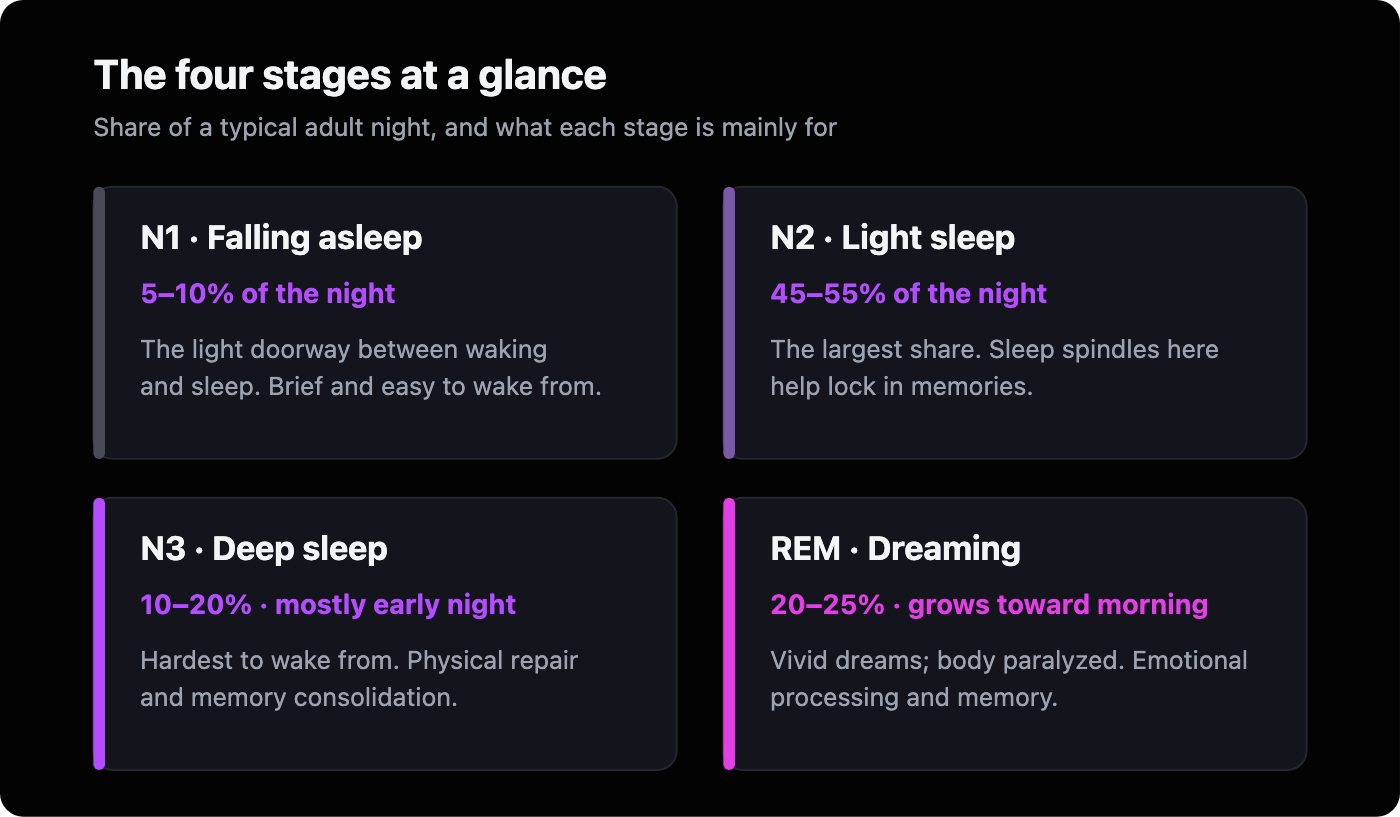
Modern sleep medicine, following the American Academy of Sleep Medicine (AASM), splits sleep into four stages: N1, N2, N3, increasingly deep non-REM sleep, and REM, the stage most associated with vivid dreams. If you've seen older references to "stages 1 through 4," that's the same system before it was revised; the old stages 3 and 4 were merged into today's N3.
These stages don't occur once. They cycle, and one full pass takes about 90 minutes, so a typical night runs through four to six of them. Crucially, the cycles aren't identical, and the balance of deep sleep and REM shifts steadily from the start of the night to the end.
N1: The Doorway Into Sleep
N1 is the brief transition from being awake to being asleep. It's the lightest stage, usually lasting only a few minutes, and it makes up roughly 5 to 10 percent of the night. Your muscles relax, your brain waves begin to slow, and you're easily woken. If someone speaks to you here, you might insist you were never asleep.
This is also the stage of the sudden falling sensation or muscle jerk that can jolt you awake. N1 is a threshold, not a destination. On a healthy night you pass through it quickly and move on.
N2: Where You Spend Most of the Night
N2 is light sleep, and it's the workhorse stage, around 45 to 55 percent of your total sleep, more than any other. Your heart rate and body temperature drop, and you become harder to wake than in N1.
On an EEG, N2 has its own signatures: short bursts called sleep spindles and sharp waves called K-complexes. Neither is a mere curiosity, because spindles are tied to locking in memories and to keeping you asleep through minor disturbances, so this "light" stage is quietly doing real work, not just filling the gaps between the deeper phases.
N3: The Deep, Restorative Stage
N3 is deep sleep, also called slow-wave sleep for the large, slow brain waves that define it. It's the hardest stage to wake from. Pulled out of N3, you'll feel groggy and disoriented, the state known as sleep inertia. It accounts for roughly 10 to 20 percent of sleep in younger and middle-aged adults, and it's concentrated in the first half of the night.
Deep sleep is when much of the body's physical maintenance happens. It's the stage that releases most of the night's growth hormone and supports the consolidation of facts and events into longer-term memory, a rebuilding process that depends on the precise timing of the brain's slow waves and spindles, and that we unpack in how sleep consolidates memory.
It's also linked to the brain's waste-clearance system, sometimes called the glymphatic system, a network that flushes metabolic byproducts out of brain tissue. Early work suggested this clearance ramps up during deep sleep, which would give N3 a role in keeping the brain healthy over the long term. It's a genuinely exciting idea, but one still under active debate, much of the foundational research was done in mice, direct evidence in humans only began to arrive very recently, and some 2024 studies have even questioned how much sleep boosts clearance at all. Treat it as a promising lead, not a settled fact.
REM: The Active, Dreaming Stage
REM, rapid eye movement sleep, is the strangest stage to describe, because on an EEG it looks almost like being awake. Brain activity surges, the eyes dart back and forth behind closed lids, and this is where the most vivid dreams occur, dreams built, as content analysis shows, out of your own memories, people and preoccupations. At the same time, your major muscles are temporarily paralyzed, a state thought to keep you from physically acting out those dreams.
REM makes up about 20 to 25 percent of adult sleep, but it isn't spread evenly. REM periods are short early in the night and grow longer with each cycle, so most of your REM sleep happens in the final hours before waking. This is why dreams so often feel freshest first thing in the morning. You're simply more likely to surface out of a long stretch of REM. Holding on to one once you're awake is a separate skill, and a learnable one.
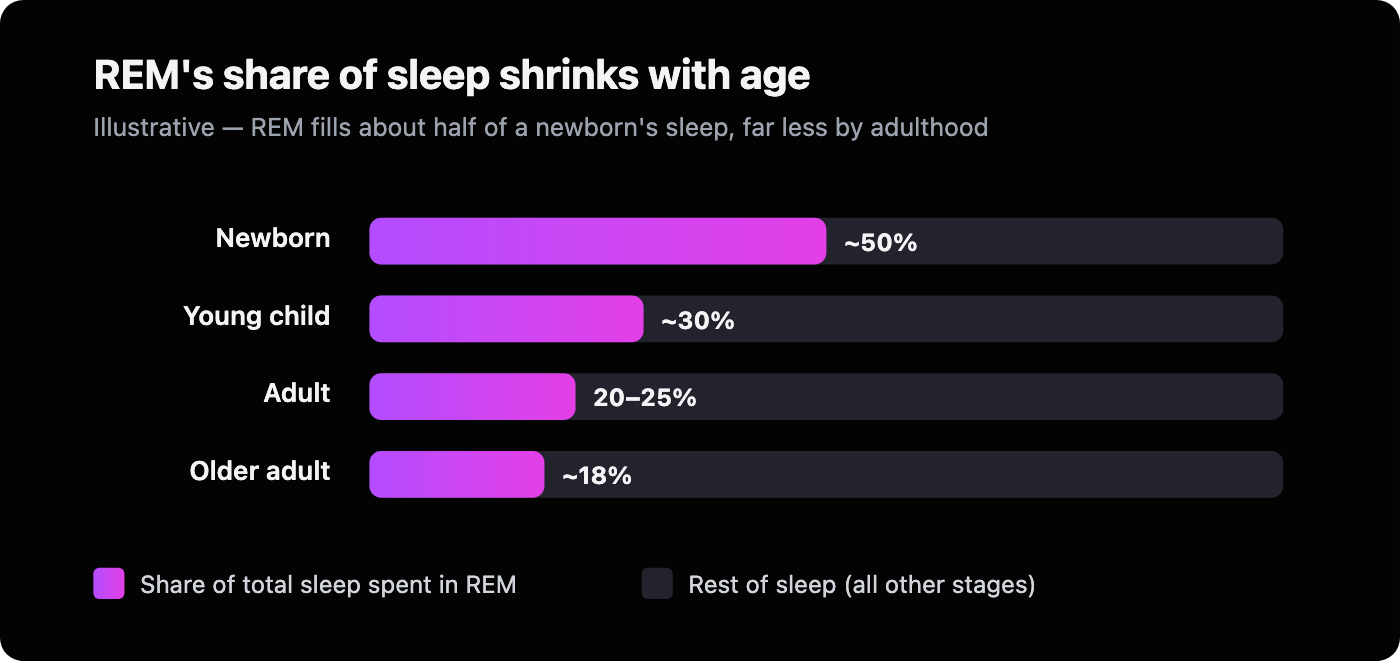
The proportion of REM also changes dramatically across a lifetime. A newborn spends around half of sleep in REM; that share falls through childhood and settles into the adult range. After that it declines only very slowly, and what happens to the dreams themselves over those decades shows up in a journal rather than in percentages.
Lucid Dreaming Lives Inside REM
REM is also the home of one of the more remarkable things the sleeping brain can do, become aware that it's dreaming. In a lucid dream, you know you're asleep while the dream is still running, and sometimes you can steer it.
This is not fringe territory at all, since in the 1980s, the psychophysiologist Stephen LaBerge found a way to prove lucid dreaming happens. Since the body is paralyzed during REM but the eyes still move, a dreamer who becomes lucid can signal it by moving their eyes in an agreed pattern, left-right, left-right, while a sleep lab confirms, on the EEG, that they're genuinely in REM. Later brain-imaging work, notably by Martin Dresler's group at the Max Planck Institute, showed that the prefrontal cortex, the self-aware, decision-making region that normally goes quiet in REM, partly switches back on during a lucid dream. That's why lucid dreaming sits in an unusual middle ground, with features of both waking and ordinary dreaming.
It's more common than you might expect. A large 2016 meta-analysis estimated that around 55% of people have had at least one lucid dream, and roughly a fifth have them monthly. Whether lucid dreaming can be reliably trained is a livelier question, namely some techniques show promise in the lab, but results vary and the evidence is still developing. Most of those methods lean on the same groundwork, though, noticing the recurring "dream signs" that tell you you're asleep, running reality checks, and keeping track of which techniques you're practicing. Alisie is built around exactly that groundwork. You mark the dream signs in your own entries, and the app tallies them, so the ones that keep coming back become visible. Separately, you set your own reality-check reminders, choosing the times and interval at which the app nudges you to run one. What's settled is where it happens, namely lucid dreaming is a REM phenomenon, which is one more reason the stage matters.
Why the Order Matters, Not Just the Hours
Lucid dreaming aside, the ordinary structure of a night has consequences of its own. Line the cycles up and the shape becomes clear: early cycles are heavy on deep N3 sleep, later ones on REM. This layout, which sleep scientists call the "architecture" of a night, carries a practical implication most sleep advice skips over.
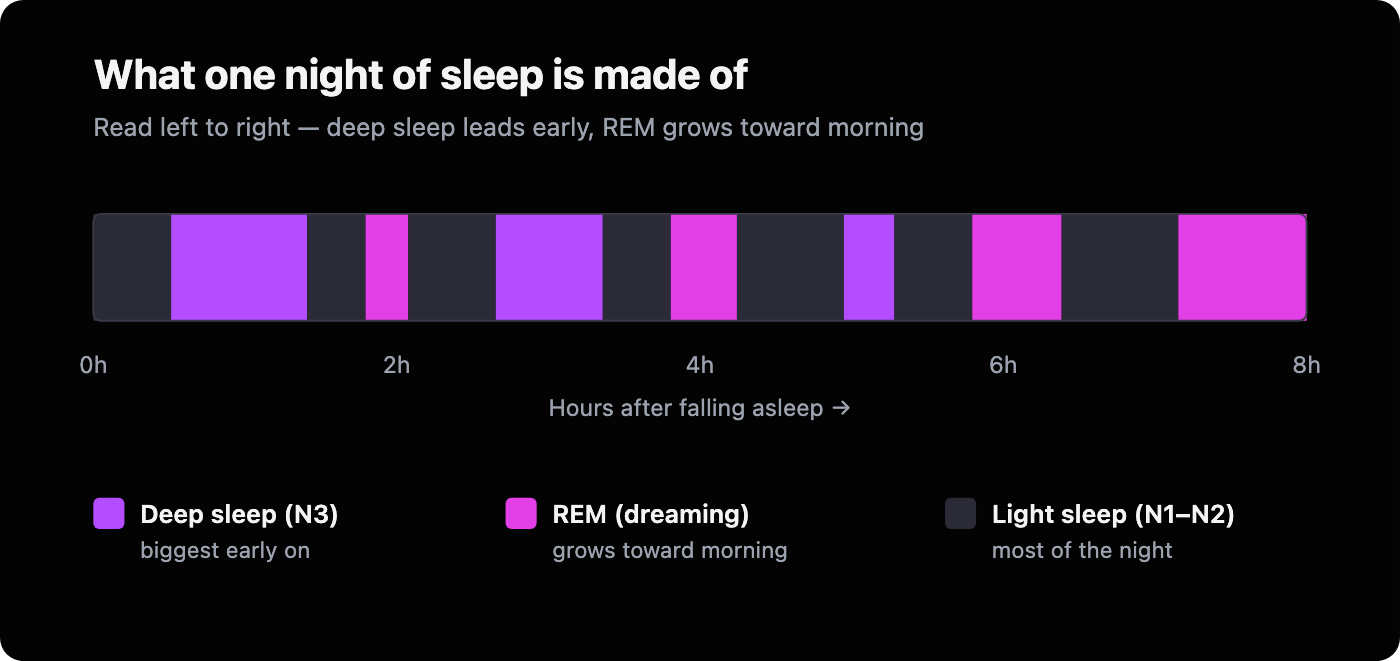
Because deep sleep loads the front of the night and REM loads the back, cutting your sleep short doesn't trim each stage evenly. It disproportionately costs you REM. Go to bed far too late and you shortchange deep sleep instead. In other words, the timing and continuity of sleep shape what kind of sleep you actually get, not only how much. Eight hours broken into fragments is not the same as eight hours in sequence.
What Cuts REM Short - and Takes Your Dreams With It
Because REM is stacked into the last cycles of the night, anything that shortens or suppresses it comes for your dreams first. That is the part usually left out of the advice, namely a lost hour of REM is not an abstract number in a chart, it is the two or three longest dreams of your night, the ones you would actually have remembered.
The clearest example is the alarm clock. Waking an hour early doesn't shave an even slice off each stage, because it cuts almost entirely from REM, because that is what the final hours are made of. You keep your deep sleep and lose your dreams. It is also why people who sleep six hours often insist they don't dream. They mostly aren't around for the part of the night where dreaming concentrates.
Two other things reliably suppress REM. Alcohol noticeably cuts it in the first half of the night, which is why a heavy evening tends to be followed by a blank morning, and then by unusually vivid, crowded dreams a night or two later, as the missed REM comes back. Most antidepressants, SSRIs in particular, reduce it as well; that is worth understanding if your dream life has gone quiet, but it is not a reason to stop a prescribed medication without talking to a doctor.
There is no switch that adds REM on demand. What protects it is unglamorous and well established, namely enough hours, at a steady time, so the last cycles actually happen. Sleep long enough and the dreams are there. The question is whether you're awake for them, and whether you catch them before they go.
A Tracker Can't Tell You What You Dreamed
Plenty of people now wear a device that reports "REM" and "deep sleep" percentages. Two things are worth knowing about those numbers. First, they are estimates, consumer wearables infer stages indirectly, mostly from movement and heart rate, while clinical staging uses polysomnography, direct measurement of brain waves, eye movement and muscle activity. They are useful for broad trends across weeks, not as a stage-by-stage reading of one night.
Second, and more to the point, even a perfect tracker would only tell you that you were in REM. It cannot tell you what happened there. The one record of your night that captures the actual content, meaning who was in it, where it took place and what it was about, is the one you write yourself, in the minutes after you wake.
The Short Version
Sleep is a structured cycle, not an on-off switch. You move from the light doorway of N1, through the long stretch of N2, down into restorative N3 deep sleep, and up into vivid REM, roughly every 90 minutes, four to six times a night. Deep sleep dominates the early hours and handles physical repair; REM builds toward morning and is where most dreaming happens.
All four stages matter, and their order across the night is part of how sleep does its job, which is why the goal isn't to chase one stage but to let the whole sequence run. Do that, and the architecture of the night hands you something specific, your longest, richest dreams, delivered in the hour before you open your eyes. They are also the most fragile thing your night produces, and they don't survive the walk to the kitchen. Knowing the shape of your night tells you exactly when to catch them.