 Alisie
The Psychology of Dreams and Why Dream Dictionaries Fail
Dream psychology is a genuine science with a century of data behind it. It just doesn't do the thing most people expect. It cannot tell you what a snake in your dream means, and no research ever will. Not because dreams are meaningless noise, but for a far more interesting reason. Your dreams are built out of your own memories, people and preoccupations, so the same symbol carries a different charge for every dreamer. There is no universal dictionary because there is no universal dreamer. What the science can do, with real precision, is describe what dreams contain, how their content tracks your waking life, how dreaming develops in childhood, and the one method that does reveal what a recurring image means to you.
Dreams Became Measurable in 1966
The reason there is a science here at all is that someone found a way to count dreams.
In 1966, Calvin Hall and Robert Van de Castle published a coding system that turned dream reports into data. Characters, settings, social interactions, aggression, friendliness, emotions, misfortunes. Each element got a category and a rule for scoring it, so two researchers reading the same dream would tally the same things. Their norms came from 1,000 dream reports written by 200 American college students, five dreams each. Nearly sixty years on, it remains the best-validated and most widely used system in the field.
That single methodological move separates dream psychology from dream interpretation. An interpretation cannot be wrong in any way that matters; a count can. And once you can count, you can ask whether men and women dream differently, whether dreams change across cultures, whether one person's dreams stay stable across decades, questions with answers.
The norms carry an obvious limitation, and it is worth naming before leaning on them, 200 mid-century American undergraduates are not humanity. Every figure below inherits that. What rescues them is that the broad patterns have since replicated in other countries and other decades, which is the strongest argument that content analysis is measuring something real rather than a local artifact of 1960s campus life.
The infrastructure grew from there. DreamBank, built by G. William Domhoff and Adam Schneider, held over 22,000 dream reports as of its 2008 write-up and has grown since. It is a searchable public archive that includes individual series running to thousands of dreams from a single person. More recent work has pushed automated analysis across tens of thousands of reports at once. The subject matter is strange; the method is ordinary science.
Most Dreams Are Far More Boring Than You Think
The popular image of dreaming, surreal and chaotic and physically impossible, turns out to be a sampling error. You remember the dream where your teeth fell out and you were flying over a city made of glass. You do not remember the dream where you were in a kitchen, talking to a colleague, mildly annoyed.
Coded systematically, dreams are mostly the second kind. Around 60-80% of dream reports are rated highly coherent, and only about 2% rate high on bizarreness. Exotic settings account for roughly 5% of dreams; the rest happen in commonplace, familiar places. Talking shows up in the overwhelming majority of reports, while active physical exertion appears in only 15-20% of them. Dreams are conversational, social, and largely realistic, closer to drifting thought than to a surrealist film.
Two well-replicated exceptions to the general blandness are worth knowing. Emotions in dreams skew negative, fear, anxiety and apprehension dominate, followed by anger and sadness, with positive emotions in the minority. That baseline is why a bad dream is not, in itself, a signal, because nightmares are the far end of a distribution that leans dark to begin with, and it is their frequency, not their existence, that means anything. Conflict is common without being the whole story. In the Hall/Van de Castle norms, at least one aggressive interaction shows up in 47% of men's dreams and 44% of women's, but friendliness appears in 38% and 42% of them respectively. Both are close to half, and neither dominates. So the correction here is to the picture of dreams as surreal chaos, not to the idea that there is conflict in them.
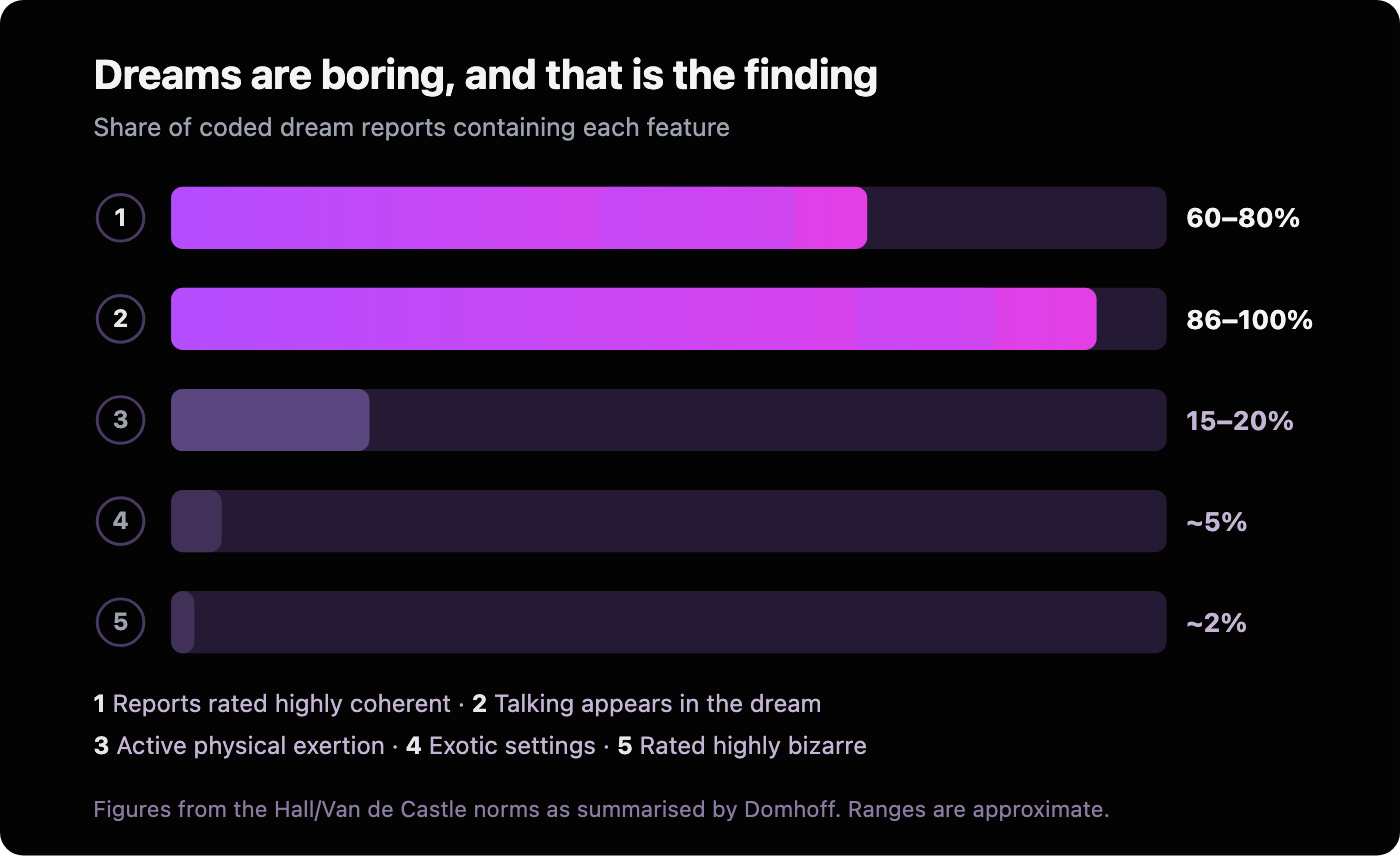
One methodological caveat belongs right here: how you measure changes the answer. Dreams rated by outside judges come out more negative than the same dreams rated by the dreamer. Both numbers are real; they are measuring slightly different things.
Your Dreams Are About Your Life - Not in Code
The central finding of modern dream research is also its least mystical: dream content is continuous with waking life. Your dreams are populated by the people you know, the places you go, and above all the things you care and worry about. This is called the continuity hypothesis, and it is the closest thing the field has to a consensus. Its cleanest demonstration is the Tetris effect, spend a day absorbed in something and it comes back at sleep onset, rebuilt rather than replayed.
The most persuasive evidence comes from long individual dream series. Domhoff analysed the dream diary of a woman known as "Barb Sanders", spanning more than 20 years. Her pattern of aggressive and friendly interactions with specific people in her dreams tracked the actual ups and downs of those same relationships in her waking life, the people she clashed with awake were the people she clashed with asleep, no symbolism required. Adults over about 25 show dream content that stays recognizably consistent across years and even decades, which is to say your dreams are stably, measurably yours.
Continuity is selective, though, and the exceptions are revealing. Dreams over-represent what preoccupies you and systematically under-represent large parts of what you actually do, reading, writing, typing, arithmetic and screens are strikingly rare in dreams, despite consuming much of modern waking life. So dreaming is not a recording of your day. It is a continuation of your concerns.
If you want a demonstration that dream content tracks reality with almost absurd fidelity, consider the dream researcher Michael Schredl's own journal, 14,520 of his dreams recorded between 1984 and 2019. Mentions of snow, ice and hail declined across those decades, mirroring the measured decline in freezing "ice days" in Germany over the same period. His dreams warmed up along with the winters outside. (Seasons leave shorter-term marks too, dream recall itself runs lower in winter than in spring or autumn.) It is a single dreamer, so treat it as an illustration rather than proof, but it is a striking one.
Dreams Reflect the Dreamer - and That Is Now Measurable
If dreams follow waking life, they should also follow the person living it. They do, and the best evidence for this is recent.
A study published in Communications Psychology in April 2026 analyzed 3,366 dream and waking reports from 207 adults collected between 2020 and 2024, alongside cognitive, psychometric and sleep measures. Stable individual traits predicted dream content selectively, and three traits in particular:
- Attitude toward dreaming. People who regard dreams as meaningful report dreams richer in content across multiple dimensions.
- Mind-wandering. Those more prone to mind-wandering while awake produce dream reports with more frequent shifts of setting, which maps closely onto the subjective sense that a dream was bizarre.
- Sleep quality. How well people rated their own sleep shaped their dream content too.
The same study caught external events registering in dreams. During COVID lockdowns, dream reports carried more references to restriction and limitation, and greater emotional intensity. It also found a clean structural difference between dreaming and waking thought. Compared with waking reports, dreams shift away from self-referential, thought-centered narration toward perceptual experience, dominated by visuo-spatial detail, multiple characters, and bizarre events. The reflective, self-aware mode does not vanish entirely, though. It can switch partly back on mid-dream, which is what happens in a lucid dream.
That is a different shape of finding from the one most people expect. Not "dreams about water mean X," but "your dreams differ from someone else's in ways that follow from who you are and what is happening to you." It is also the shape dream psychology can actually deliver.
The Themes Almost Everyone Has
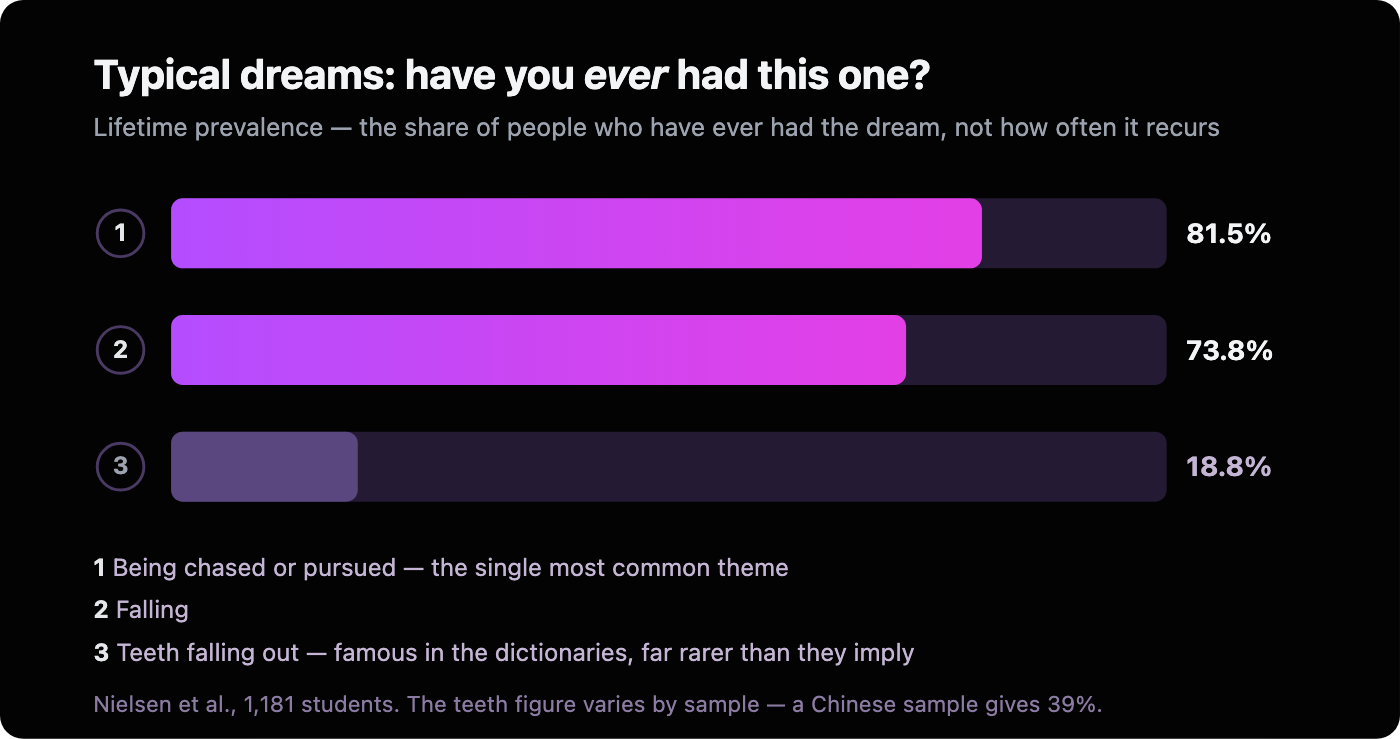
Some dreams do recur across people and across cultures. Researchers call them typical dreams, and the prevalences are well documented. In a survey of 1,181 university students by Tore Nielsen and colleagues, the lifetime figures, meaning the share of people who have ever had the dream, came out like this:
- Being chased or pursued: 81.5%, the single most common theme, and a dream worth reading closely
- Falling: 73.8%
- Also very common: arriving too late, being on the verge of falling, trying again and again, flying, and sexual dreams
Teeth dreams, the most famous entry in every dream dictionary ever printed, turn up at 18.8% in Nielsen's sample, while a later study on a Chinese sample puts the lifetime figure at 39%, with 16.2% having them recurrently. The theme is common; exactly how common depends on who you ask. What is consistent is the ranking, namely Japanese and American respondents order these themes in strikingly similar ways.
Here is where the science and the symbol dictionaries part company, and the teeth are the cleanest example. When researchers investigated teeth dreams empirically, in a 2018 study of 210 students, the correlate they found was not anxiety, loss, or any of the meanings the dictionaries assign. Teeth dreams tracked dental irritation and tension on waking, a small but real association, while showing no relationship at all to psychological distress. One study on a student sample is not the last word, and the researchers were careful about that. But it is more evidence than the entire symbol-dictionary tradition has ever produced, and it points at the body rather than at a hidden message.
The right reading of typical dreams is more interesting than a code. These themes are shared simply because human predicaments are shared, every body knows how to fall, every social animal risks being chased or humiliated, and all of us are late for something. A common theme is evidence of a common situation, not of a common hidden meaning.
Why a Dream Dictionary Cannot Work - the Real Reason
It is worth being precise about why the dictionaries fail, because the usual explanation is wrong and insulting. The problem is not that dreams are random noise, and it is not that people who find their dreams meaningful are being credulous. It is arithmetic.
A dictionary assigns one meaning to a symbol for everybody. But the evidence says dream content is assembled out of your memories, your relationships, your preoccupations, and those are not shared. A dog in your dream draws on the dog you grew up with; a dog in mine draws on the one that bit me. Water carries whatever water carries for a person who nearly drowned, and something entirely different for someone who swims every morning. Same image, different source material, different associations, different weight. The symbol is identical and the meaning is not even comparable.
Which means every dreamer is running a private vocabulary, built by their own life and no one else's. That is not a mystical claim. It is the continuity hypothesis, restated. And it is exactly why the science, when it wants to learn something real about a dream, never reaches for a dictionary. It reaches for a series, many dreams from one person, coded and counted, so the recurring elements and their associations emerge from that dreamer's data. Barb Sanders's mother meant something specific in Barb Sanders's dreams, and it was legible only because there were twenty years of her dreams to read it from.
The dictionary asks what a symbol means. The useful question is what it means to you, and that one has an answer, but only your own record can give it.
Why We Dream: Still Open - But Not in the Way You'd Think
This is where an honest article has to slow down. Despite everything above, there is no scientific consensus on why we dream, or whether dreaming has a function at all. Any confident single answer you encounter is running ahead of the evidence. Four hypotheses are currently in play.
Before they get confused with each other, one thing needs stating up front, because it is the most misread point in all of dream science. The open question is about the function of dreaming as a mechanism, namely what, if anything, it evolved for. It is not a question about whether your dreams are random. None of these four hypotheses says the content is arbitrary. Every one of them takes for granted what content analysis established decades ago. Dreams are built out of your own memories, relationships and concerns. The argument is over what the machine is for, not over whose material it runs on. The material is always yours.
Emotional processing. The idea that dreaming helps metabolize emotional memories, dampening their charge overnight, is popular and has real support. A 2024 study in Scientific Reports found that dreaming prioritizes negative memories over neutral ones and reduces the next day's emotional response to them. But the picture is being argued over right now. A 2026 commentary in SLEEP by Serena Scarpelli, responding to a study in which more fear in dreams predicted more next-morning negative affect rather than less, makes the case that emotional regulation and simple continuity need not be rival explanations at all, and that if dreams do help recalibrate emotion, it likely takes several mechanisms working together, not dreaming alone.
Memory consolidation. A 2023 meta-analysis of 16 studies found that people who dream about a task they learned before sleep reliably outperform those who don't. That is a real and replicated link. Note carefully what it does not establish: that the dreaming causes the consolidation. The dream may simply be what memory reactivation looks like from the inside, which is the reading the evidence on how sleep consolidates memory actually supports, and it explains why what you learn comes back recombined rather than replayed.
Threat simulation. Antti Revonsuo proposed that dreaming evolved as a rehearsal system for danger. It is an elegant theory that the numbers do not support especially well: only about 21% of dreams contain a physical threat of any kind, only 8.5% of dreamers report a realistic life-threatening event, and a realistic escape follows in roughly a third of those. There is no direct evidence that dream rehearsal improves waking performance.
No evolutionary function. Domhoff, after fifty years of empirical dream research, concludes that dreaming was probably never selected for, and that it runs on the default mode network, the same system that produces mind-wandering, let loose when nothing external demands attention. Dreams, on this account, happen because the machinery for imagining exists, not because dreaming earned its keep in evolution.
Read the fine print, though, because this is the position most often mangled into "dreams are meaningless." Domhoff is the man who spent those fifty years counting dream content and demonstrating it maps onto the dreamer's waking concerns. His claim is that dreaming has no evolutionary job, while insisting dreams are psychologically revealing, because they are made of you. On his own account dreams are "imaginative but realistic simulations" of your life. That is close to the opposite of noise.
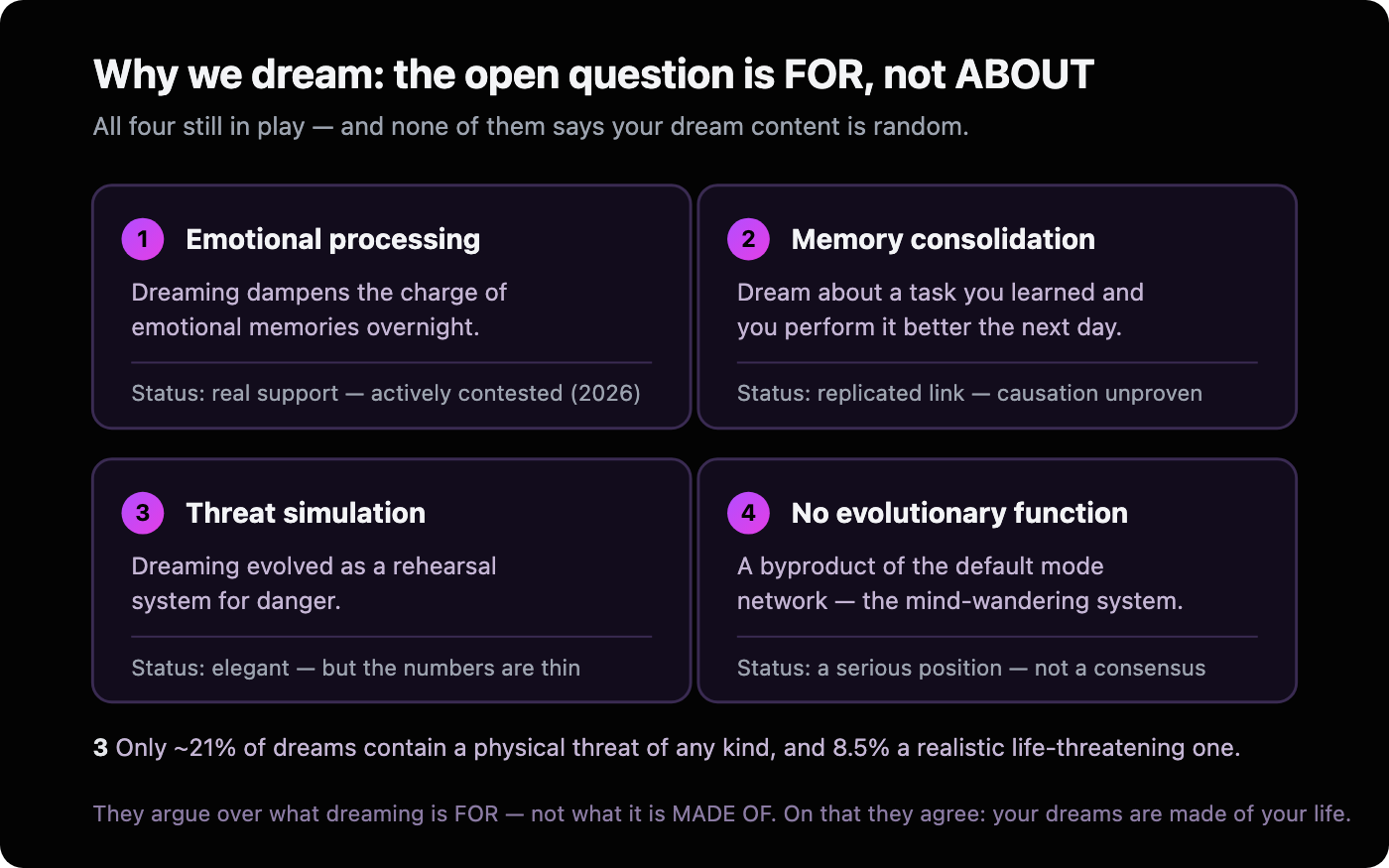
So the honest summary is narrower, and far less deflationary, than the headline suggests. Science does not know what dreaming is for. It knows exactly what dreaming is about. A thing does not need a survival purpose to tell you something true about yourself, and a mechanism whose raw material is your own memories, people and preoccupations is not producing static.
What Happened to Freud
Most people who say "the psychology of dreams" are thinking of Freud, so it is worth being clear about where his theory stands: it is history, not current science.
Freud's claim was that dreams are disguised wish fulfillment, namely that a censor converts unacceptable latent content into acceptable manifest content, and that interpretation decodes it back through free association and symbols. Evidence-based psychology dropped it, for reasons that are not a matter of taste, and the full account of how the theory was tested and where it broke runs through all three of them.
Start with the fact that it cannot be falsified, latent content, the censoring mechanism, and universal symbolism cannot be stated as claims that any data could refute. Its method permits infinitely many interpretations, with nothing to constrain which is right, because whatever surfaces during free association gets treated as evidence of what caused the dream, when it is nothing of the kind. And where the theory does make contact with data, the data go the other way. Coded dreams look mundane and continuous with waking concerns, not disguised. Then there is the evidence from children.
Dreaming turns out to be something you develop. David Foulkes ran the landmark work: children followed longitudinally for five years in a sleep lab, across hundreds of awakenings, spanning ages 3 to 15, plus a cross-sectional replication with 80 children aged 5 to 8. The youngest children's dreams were rare, static and bland: a single image, often an animal or a body state, with almost no narrative, little emotion, and no dreamer in the scene. By ages 7 to 8, reports get longer and genuinely narrative, and children begin to appear in their own dreams as actors. True narrative dreaming arrives around ages 7 to 9, tracking the development of waking cognitive and visuospatial skill. Dreams keep shifting for the rest of a life, both what they contain and how much of them reaches morning.
This is devastating for a theory that requires infants to dream disguised wish-dramas, and it is strong support for the view that dreaming is built out of the same machinery as waking imagination.
Something does survive the wreck, though, in that Freud was right that dream content is not random and that it connects to the dreamer's psychological life, and continuity vindicates that much. Disguise, censorship, universal symbols, and the whole project of decoding are what failed. Which leaves a distinction worth holding onto: dreams are meaningful about you, but there is nothing hidden in them to decode. The meaning is in the patterns, and the patterns are in plain sight, if you have kept a record long enough to see them.
It is worth knowing where the dream dictionaries came from. They descend from Freud and Jung, not from research. That settles nothing about what anyone should take from their own dreams. It only means the entries in them were never findings.
Build the Only Dream Dictionary That Works: Your Own
Look at how every real finding in this article was produced, twenty years of Barb Sanders's diary, 3,366 reports from 207 adults, Schredl's 14,520 dreams that tracked the German winters. In each case the method was identical: collect one person's dreams over time, then count what repeats.
That is the whole method, and it is available to you. Not because a symbol has a fixed meaning, but precisely because it doesn't. The only place your private vocabulary is written down is in your own dreams, and it takes a series to read it. What the science does with a dream series is not mysterious. It counts who shows up, where, how often, alongside what, and how it all moves as life moves. Do that with your own dreams for a few months and you have something no dictionary can sell you, an encyclopedia of your dreams, sourced from the only reliable authority on them.
This is where a journal stops being a diary and becomes an instrument. Alisie is an iOS dream journal built to run that method on your own archive.
The step that made dream research possible in 1966 was coding, labelling who and what appears in each dream. You do the same thing when you mark the characters, creatures, locations, artifacts and whatever else stood out in an entry, and the app then tallies them across everything you have written, so the recurring ones rise to the top on their own instead of depending on your impression of what recurs. That is personal content analysis, and it is how a cast of characters emerges from what felt like unrelated nights.
Barb Sanders's case turned on something a tally alone won't show, not just who appeared, but who appeared with what. Alisie's Dream Connections graph maps how the elements of your dreams link to each other, which characters travel with which locations, which artifacts keep company with which places. Those associations are your private vocabulary, drawn as a map.
The continuity finding, that dreams follow waking concerns, is checkable rather than take-it-on-faith. Tag what is going on in your life and you can watch which threads make it into the dreams, and which don't. The emotional skew the norms describe is checkable the same way, through the emotion trends over months, your own data may or may not lean the way the textbooks say.
None of it interprets anything for you. It counts, which is the only thing the science does either. (And all of it rests on the step before, because if the dreams are gone before you can write them down, start with how to remember your dreams.)
What your dreams mean is yours to work out, and no study is going to settle it for you. What research can hand you is the method it uses on itself and, if you keep the record, the raw material to use it on.
The Short Version
Dream psychology is a real empirical science, and it has been one since dreams became countable in 1966. It has established that dreams are mostly mundane rather than surreal, that they skew emotionally negative, that their content is continuous with the dreamer's waking concerns and stable over decades, that individual traits like attitude toward dreaming and mind-wandering predict what your dreams are like, and that dreaming is a cognitive achievement children grow into around ages seven to nine. It has ruled out Freud's decoding machinery and never found a universal symbol dictionary, not because dreams are noise, but because the vocabulary is private, your dreams are assembled from your life, so a symbol's meaning is yours and no one else's. What it has not settled is what dreaming is for. What it settled long ago is what dreaming is about. The science gives you a method rather than an oracle, keep the record, count what repeats, and read the only dream dictionary that was ever going to work: the one your own dreams write.